
A Global CMMI Level 3 Company
Supabase Development Company

Supabase Development Company

Book a Free Consultation Call Assured Response in 1 Business Day!
✓ Valid
Loading...
PostgreSQL Core Rapid Development AI-Ready

Accelerate Product Development with Expert Supabase Developers

Build secure, scalable and AI-ready digital products with Owebest Technologies, a Supabase development company combining modern backend engineering with deep expertise in PostgreSQL, React, Next.js, Node.js, Laravel, mobile technologies and artificial intelligence. We help startups, growing businesses and enterprises use Supabase to launch new products faster, modernize existing applications and create reliable backend foundations without spending valuable engineering time rebuilding common infrastructure.

From a new SaaS MVP to a complex customer platform, marketplace, internal business application or AI-powered product, our Supabase development services can cover architecture, database design, authentication, authorization, realtime experiences, storage, API integration, Edge Functions, testing, deployment and ongoing optimization. If you already have an application, we can also assess where Supabase fits into your current stack rather than forcing a complete rewrite.

Our approach is practical: use Supabase where it improves speed, maintainability and product economics; retain Laravel, Node.js or other backend services where complex domain logic, long-running jobs, specialized integrations or existing architecture make them the better choice. The result is a solution designed around your business and engineering requirements—not around a technology trend.

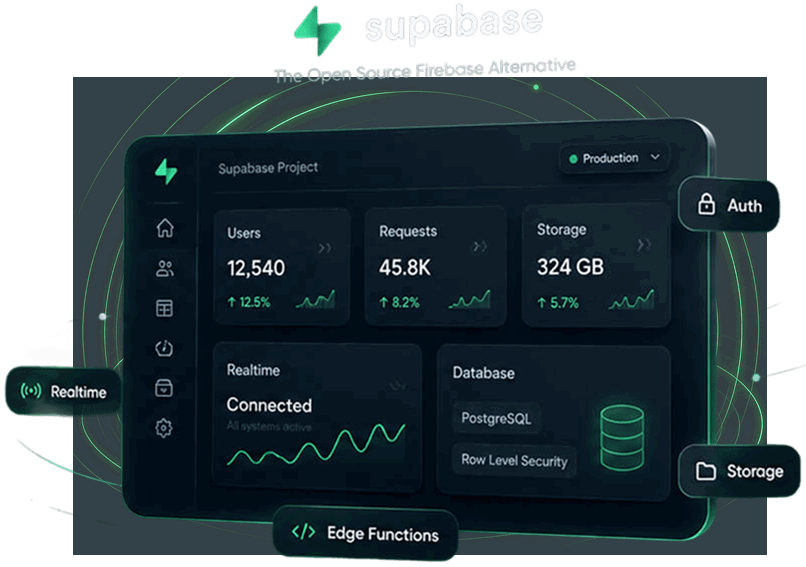
PostgreSQL Core Relational Database Supabase Auth Secure RLS Policies Realtime Sync WebSockets Ready Edge Functions Serverless TypeScript
Global CMMI
Level 3 Company
Full-Cycle Product
Engineering
AI, SaaS &
Enterprise Expertise
Flexible Engagement
Models
Web, Mobile, Backend
& Cloud Teams

Build Modern Products on a Powerful PostgreSQL Foundation

Modern software teams are under pressure to deliver more functionality in less time. Yet a large part of backend development is often spent on capabilities that every application needs: user management, database access, authorization, file handling, APIs, realtime events, server-side functions and deployment workflows.

Supabase brings these building blocks together around a full PostgreSQL database, giving product teams a strong foundation for building modern web and mobile applications.

Why Architecture Matters

For businesses, the attraction is not simply that Supabase is convenient for developers. A well-designed Supabase architecture can shorten the path from concept to production, reduce unnecessary infrastructure work and allow engineering teams to spend more time on the features that differentiate the product. Because PostgreSQL remains at the center of the platform, organizations can use relational modeling, SQL, database functions, extensions and established data engineering practices instead of committing their core product data to an unfamiliar proprietary database model.

Owebest helps clients translate those capabilities into production systems. We evaluate data relationships, access patterns, security boundaries, expected traffic, integration requirements, reporting needs and future scaling plans before defining the implementation. That matters because the fastest way to build an MVP is not always the right architecture for a product expected to support multiple teams, thousands of customers or enterprise workflows.

Our Supabase Development Services

Whether you need an end-to-end product team or experienced engineers to strengthen an existing team, our Supabase development services can be shaped around the stage of your product and the complexity of your application.

Custom Supabase Application Development

We design and develop custom applications using Supabase as part of a modern technology stack. This can include customer portals, marketplaces, operational dashboards, workflow platforms, subscription products, collaboration tools, mobile backends and data-driven applications. Our team defines the data model, access controls, APIs and integration boundaries before connecting the backend to React, Next.js, mobile applications or other client experiences.

Supabase Backend Development

Use Supabase as the backend foundation for a new or existing product. We work with PostgreSQL schemas, database relationships, queries, functions, access policies, APIs, authentication, storage and realtime features. Where the application requires additional services, we integrate Supabase with Node.js, Laravel, queues, third-party APIs, payment platforms, AI services and cloud infrastructure rather than trying to place every workload inside one platform.

Supabase Database & PostgreSQL Engineering

A scalable application starts with a well-designed data model. Our engineers plan relational structures, constraints, indexes, migrations, query patterns, database functions and access policies with long-term maintainability in mind. We can also review existing PostgreSQL implementations for performance, security and data-model issues before new product development begins.

Supabase Authentication & Authorization

We implement secure user journeys for consumer, B2B and internal applications. Depending on the product, this can include password-based authentication, passwordless flows, OAuth/social providers, single sign-on requirements, session handling and role-based experiences. We connect authentication with PostgreSQL Row Level Security so access rules are enforced close to the data instead of relying only on frontend checks.

Supabase Realtime Application Development

Realtime experiences can improve products where users need immediate updates rather than manual refreshes or constant polling. We use Supabase Realtime for suitable use cases such as live dashboards, collaboration features, notifications, order or job status, presence, activity feeds and operational monitoring. We design subscriptions carefully so realtime functionality supports the user experience without creating unnecessary load.

Supabase Storage Integration

We implement public and private storage patterns for application files such as profile images, product media, documents, attachments and generated assets. Storage access can be aligned with authentication and authorization policies, while larger media-heavy or specialized delivery workloads can continue to use dedicated object storage/CDN infrastructure when that is a better architectural choice.

Supabase Edge Functions & API Integrations

For lightweight server-side logic, webhooks and integrations, Supabase Edge Functions can provide a clean way to execute TypeScript close to users. We use them where appropriate for payment webhooks, transactional workflows, notifications, third-party API calls and selected AI requests. Heavy or long-running processing is separated into suitable workers or backend services to keep the architecture resilient.

Supabase Consulting & Architecture

Not every project needs immediate development. Our Supabase consulting services help product owners and technical teams decide whether Supabase is the right fit, what should remain in an existing backend, how data should be modeled, how security should be implemented and what migration path makes sense. You receive a practical architecture and implementation roadmap instead of a generic recommendation.

Supabase Support, Optimization & Maintenance

Already running on Supabase? We can review database performance, RLS policies, query behavior, application architecture, integration patterns and production issues. Ongoing support can include feature development, security improvements, performance optimization, version-aware maintenance and engineering capacity for teams that do not want to hire a full in-house Supabase function.

Why Businesses Choose Supabase for New Applications

Supabase is attractive because it combines several capabilities that otherwise require separate services and integration work. Every project is centered on PostgreSQL and can include generated APIs, authentication and user management, realtime functionality, storage and server-side Edge Functions. This integrated model can be particularly valuable for startups and product teams that want to move quickly while preserving a familiar relational database foundation.

Faster Time to Market

Teams can begin with core backend capabilities already available and focus engineering effort on workflows, product differentiation and user experience.

PostgreSQL at The Core

A full relational PostgreSQL database supports structured data, joins, constraints, SQL workflows and an ecosystem familiar to experienced backend and data engineers.

Security Close to the Data

Row Level Security policies can enforce which records an authenticated user is permitted to read or modify, creating a strong authorization layer when implemented correctly.

Realtime Capabilities

Realtime capabilities Applications can react to data changes and user activity without building an entirely separate realtime stack for every suitable use case.

Integrated Auth & Storage

Identity and file access can be designed together with application data and security policies, reducing the number of disconnected systems a team must maintain.

Flexible Architecture

Supabase can be the primary backend for a product or work alongside Laravel, Node.js, external authentication providers, existing APIs and specialized infrastructure.

AI-ready Data Layer

PostgreSQL and vector capabilities can support knowledge bases, semantic retrieval and AI application data alongside conventional relational business data.

Hire Dedicated Supabase Developers

Need Supabase expertise without building a new internal team? Hire Supabase developers from Owebest to work on a defined project, extend your current engineering team or take ownership of a complete product module. Our developers can work across database engineering, APIs, frontend integration, authentication, realtime functionality, server-side logic and third-party integrations.

Because Supabase rarely exists in isolation, the real advantage is access to a broader engineering organization. A Supabase developer can collaborate with React and Next.js engineers, Node.js or Laravel backend developers, mobile teams, DevOps specialists, QA engineers, UI/UX designers and AI engineers as the project requires. This reduces hand-offs and makes it easier to solve architecture issues that cross technology boundaries.

Flexible Engagement Models

Choose a dedicated developer, a small cross-functional squad or a managed project team depending on your roadmap. Engagement can be structured for new product development, feature acceleration, migration, architecture remediation or ongoing maintenance. The right model should be finalized after reviewing scope, team dependencies, delivery targets and the level of ownership you expect from Owebest.

Hire a Supabase Developer
Database Engineering

Schema design, migrations, and PostgreSQL optimization.

Security & RLS

Implementation of complex Row Level Security policies.

Edge Functions

TypeScript server-side logic for third-party integrations.

Frontend Integration

Connecting Supabase seamlessly with React or Next.js apps.

Firebase to Supabase Migration Services

Organizations often consider Firebase to Supabase migration when they want PostgreSQL, relational data modeling, SQL flexibility, greater control over their data architecture or a backend that aligns better with an existing PostgreSQL skill set. Migration, however, is more than copying tables. Authentication identities, security rules, storage, server-side logic, realtime behavior, client SDK usage and deployment workflows may all need to be redesigned.

Our migration process begins with an inventory of your existing Firebase services and application dependencies. We map collections and relationships to a PostgreSQL model, identify authentication and authorization changes, define a storage migration plan, review Cloud Functions or server logic and plan how client applications will transition. For production systems, we also define validation, cutover and rollback considerations to minimize disruption.

Typical Migration Workflow

1. Discovery & Dependency Audit

Identify Firebase products, data volumes, security rules, functions and application touchpoints.

2. Target Architecture

Design PostgreSQL schema, RLS strategy, Auth approach, Storage structure and server-side components.

3. Data Migration

Transform and validate data while preserving relationships and application requirements.

4. Application Integration

Update frontend/backend code to use the new Supabase architecture.

5. Testing & Reconciliation

Verify permissions, data accuracy, critical workflows, performance and realtime behavior.

6. Production Cutover

Execute an agreed migration plan with monitoring and post-launch support.

Planning a Firebase Migration?

Supabase Development for AI & Generative AI Applications

AI products need more than a model API. They need user accounts, permissions, application data, conversation history, documents, metadata, feedback, usage tracking, integrations and often a retrieval layer. Supabase can provide a practical application backend for these requirements while PostgreSQL keeps structured business data and AI-related data within a familiar database environment.

Owebest combines Supabase development with AI engineering to build applications such as knowledge assistants, RAG platforms, internal copilots, customer-support assistants, recommendation experiences, AI-enabled SaaS tools and workflow automation products. Depending on the use case, we can store document metadata and embeddings, implement semantic retrieval, manage user or tenant access, integrate LLM providers and connect AI features to existing enterprise systems.

This separation is important. Supabase can simplify the product backend, but AI pipelines still need deliberate choices around model providers, token and inference costs, privacy, evaluation, observability and asynchronous processing. Our team designs those pieces together rather than treating the database and AI layer as unrelated projects.

Example AI Architecture

Next.js / React App
Supabase Auth
PostgreSQL + RLS
Doc/Metadata Storage
Vector Retrieval
AI/LLM Service
Response & Logging

Complex ingestion, model processing or long-running jobs can be handled by separate workers or AI services.

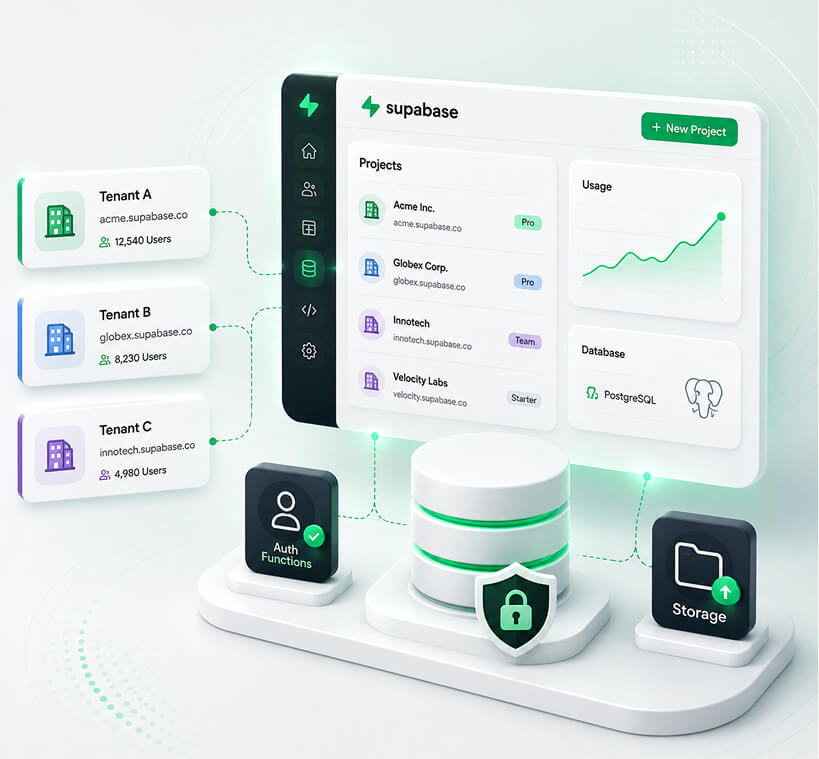
Supabase for SaaS & Multi-Tenant Products

SaaS products are a strong use case for Supabase because they commonly require authentication, account or workspace models, permissions, subscription data, file storage, APIs and realtime product experiences. The challenge is not creating the first table or login screen; it is designing tenancy, authorization and data boundaries correctly from the beginning.

Our Supabase SaaS development approach considers organizations, teams, roles, invitations, tenant-scoped records, administrative access, auditability, billing integration and future reporting requirements. We can integrate payment providers and external services through server-side functions or existing backend services while keeping sensitive operations away from the browser.

For an MVP, we prioritize a clean architecture that supports rapid validation. For a growing product, we review query patterns, indexing, connection management, background workloads, observability and operational boundaries so the system can evolve without an expensive rewrite every time usage grows.

SaaS Architecture

Technologies We Combine with Supabase

The best Supabase architecture is usually part of a wider product stack. Owebest already works across frontend, backend, mobile, database and AI technologies, allowing us to choose the right integration pattern for each application.

Next.js + Supabase

Build modern server-rendered and full-stack web products with Next.js connected to Supabase for database access, authentication, storage and selected server-side workflows. We design browser/server boundaries carefully so secrets and privileged operations remain protected.

React + Supabase

For React applications, Supabase can provide a productive backend for user-facing dashboards, portals, marketplaces and realtime interfaces. We structure data access and state flows so the frontend remains maintainable as the product grows.

Node.js + Supabase

Node.js can complement Supabase for custom APIs, workers, integrations, microservices and business logic that does not belong in client code or lightweight edge functions. This hybrid architecture is useful when a product has complex workflows or existing Node services.

Laravel + Supabase

Laravel does not need to be discarded to adopt Supabase. Existing Laravel applications can use PostgreSQL and selected Supabase capabilities while Laravel continues to own domain logic, queues, integrations and administrative workflows. We assess the value of each integration instead of replacing proven backend code without a business reason.

Mobile + Supabase

Supabase can support mobile products requiring authentication, application data, storage and realtime updates. Our mobile and backend teams coordinate API, permission and offline/latency considerations to create a consistent experience across platforms.

AI + Supabase

Combine application data, identity, permissions and vector-enabled retrieval with LLMs and AI services to build secure, user-aware AI products rather than isolated demos.

What Can We Build with Supabase?

Supabase serves as a robust backend foundation for a vast array of modern applications. Here are the core use cases we engineer for our clients.

SaaS Platforms

Multi-tenant products, subscription applications, team workspaces, dashboards and workflow software.

AI Applications

RAG systems, knowledge assistants, AI copilots, recommendation tools and generative AI products.

Marketplaces

Marketplaces Buyer/seller platforms, listings, profiles, messaging, media, transactions and operational dashboards.

Partner Portals

Secure account areas, document exchange, service status, reporting and collaboration.

Realtime Apps

Live dashboards, notifications, activity feeds, collaboration and operational status experiences.

Internal Tools

Workflow systems, approvals, reporting interfaces, data management and productivity applications.

MVPs & Startups

Fast product validation with a backend foundation that can evolve beyond the first release.

Enterprise Modules

New digital experiences integrated with existing APIs, identity systems, ERPs, CRMs and business services.

Industries We Serve

Supabase is a technology choice rather than an industry-specific platform, so we adapt the architecture to the workflows, data sensitivity and integration requirements of each sector. Owebest can apply Supabase within solutions for:

Built for Enterprise

Security-First Supabase Architecture

Speed is valuable only when it does not weaken security. Supabase Auth uses JWT-based authentication and integrates with PostgreSQL Row Level Security, allowing access rules to be enforced at the database level.

We treat RLS policy design as an architectural task, not a last-minute checkbox. Policies should be explicit, testable and aligned with user, role and tenant boundaries.

Public vs. Privileged

We separate public client operations from privileged server operations, ensuring sensitive backend functions are fully restricted.

Credential Protection

We protect service credentials and rigorously validate webhook signatures to secure server-to-server and third-party integrations.

Storage Security

Careful review of storage access policies ensures that only authorized entities can view, upload, or modify application files.

Regulated Workloads

For enterprise workloads, security and compliance requirements are evaluated against exact data, geography, and regulatory obligations.

Our Supabase Development Process

We follow a highly structured, agile methodology to transform your product vision into a robust, scalable architecture powered by Supabase.

01
Discovery & Product Goals

We understand users, workflows, existing systems, product priorities, expected scale and delivery constraints.

02
Architecture & Data Design

We define the role of Supabase, PostgreSQL schema, tenancy, RLS, integrations, backend boundaries and deployment approach.

03
UX & Application Planning

For end-to-end projects, product flows and interface requirements are aligned with backend capabilities before implementation.

04
Agile Development

Features are delivered in manageable iterations with frontend, backend, database and integration work coordinated as one product.

05
QA & Security Validation

We test core workflows, permissions, edge cases, APIs, data behavior and production-critical paths.

06
Deployment & Launch

We prepare environments, migrations, monitoring and release activities based on the project’s operational requirements.

07
Optimization & Support

After launch, we can continue with performance tuning, feature development, security improvements and product scaling.

Ready to Discuss Your Architecture?

Share your requirements with us. Get an in-depth architecture and delivery discussion to ensure Supabase is integrated perfectly into your next big launch.

Share Your Requirements

Why Choose Owebest as Your Supabase Development Company?

Choosing a Supabase development agency should not come down to who can create tables fastest. Production products require decisions across data architecture, frontend engineering, backend logic, security, integrations, DevOps, QA and product experience. Owebest brings those capabilities together so clients can work with one engineering partner from discovery through launch and ongoing development.

Full-Stack Capability

Supabase projects can be supported by specialists across React, Next.js, Node.js, Laravel, mobile, PostgreSQL, AI, cloud and QA.

Business-First Architecture

We evaluate whether Supabase should own a capability instead of using it simply because it is available.

CMMI Level 3 Process Maturity

Owebest publicly positions itself as a CMMI Level 3 company, supporting a process-driven approach to delivery and quality.

AI & Modern Product Engineering

Our AI development capabilities allow Supabase to be integrated into real AI products, knowledge systems and intelligent workflows.

Flexible Team Models

Clients can engage a dedicated developer, extend an existing team or assign end-to-end delivery to a managed project squad.

Long-Term Maintainability

We design for the product after launch—considering security, migrations, data growth, integrations and future feature development.

Supabase Vs Traditional Custom Backend Which Should You Choose?

Supabase does not eliminate the need for backend engineering. It changes where engineering time is spent. For many products, built-in database, auth, storage, realtime and API capabilities can remove repetitive infrastructure work. A fully custom Laravel or Node.js backend may still be preferable for specialized domain logic, long-running processing, unusual infrastructure constraints or systems already built around mature backend services. Many successful architectures use both.

Database

VS
Supabase-led

Managed PostgreSQL foundation

VS
Traditional Custom

Team selects, provisions and manages database architecture

Authentication

VS
Supabase-led

Integrated Auth available

VS
Traditional Custom

Implemented or integrated separately

Realtime

VS
Supabase-led

Built-in Realtime capabilities

VS
Traditional Custom

Custom sockets/services or third-party platform

Storage

VS
Supabase-led

Integrated Storage available

VS
Traditional Custom

S3/object storage or another provider configured separately

APIs

VS
Supabase-led

Generated data APIs plus custom functions

VS
Traditional Custom

Custom controllers/routes/services

Business Logic

VS
Supabase-led

Database functions, Edge Functions and external services

VS
Traditional Custom

Fully controlled in application backend

Best Fit For

VS
Supabase-led

Rapid product development and modern data-centric apps

VS
Traditional Custom

Highly specialized workflows or established custom architectures

Frequently Asked Questions About Supabase Development

A Supabase development company designs and builds applications using Supabase capabilities such as PostgreSQL, Auth, Realtime, Storage, APIs and Edge Functions. A strong partner should also understand frontend frameworks, backend services, security, integrations and production architecture.

Yes. Owebest can provide Supabase developers or cross-functional teams based on project scope. The engagement can support a new build, an existing application, migration, feature delivery, optimization or ongoing maintenance.

Yes, Supabase can be a strong foundation for SaaS applications. Multi-tenant SaaS still requires careful design for organizations, memberships, roles, RLS policies, billing, audit requirements and tenant isolation.

Yes. Next.js and Supabase are commonly combined for modern web applications. The implementation should distinguish client-side access from privileged server-side operations and follow secure session and authorization patterns.

Yes. React applications can use Supabase for authentication, data access, storage and realtime experiences. We structure the frontend and permission model so application logic remains maintainable and sensitive operations are protected.

Yes. Node.js can complement Supabase for APIs, workers, complex integrations and business logic. A hybrid architecture is often more appropriate than trying to place every backend workload into a single service.

Yes. Laravel can continue to handle domain logic, queues, APIs and integrations while an application uses PostgreSQL or selected Supabase services. Whether this makes sense depends on the existing architecture and the capabilities you want to adopt.

Yes. A migration can include data modeling, data transfer, authentication planning, security policy conversion, storage, functions, application integration, testing and production cutover.

It can replace Firebase for some products, but the platforms differ in data model, services and application architecture. The right decision depends on your current dependencies, relational data needs, team skills and migration cost.

It can be. AI products often need identity, relational data, document metadata, permissions, vector retrieval and application APIs. Supabase can provide much of this backend foundation while specialized AI services handle model inference and processing.

Supabase’s PostgreSQL ecosystem supports vector capabilities that can be used for semantic retrieval and RAG-style applications. The retrieval design should still be evaluated for data volume, latency, relevance and security requirements.

Supabase provides security capabilities including authentication and PostgreSQL Row Level Security. Application security still depends on correct architecture, policy design, credential handling, server/client boundaries and secure development practices.

Row Level Security is a PostgreSQL capability used to control which database rows a user or role can access. In Supabase applications, it is commonly combined with authenticated user identity to enforce granular data permissions.

Supabase provides generated data APIs around the PostgreSQL database and also supports server-side functions. Complex business operations may still be implemented through dedicated backend services or controlled server-side endpoints.

Yes. Suitable use cases include live dashboards, notifications, collaboration, status updates, presence and activity feeds. Realtime subscriptions should be designed around actual product needs and expected scale.

Yes. Supabase Storage can handle application files and integrates with access-control patterns. For very large media libraries, streaming workloads or specialized CDN requirements, we may recommend dedicated object storage instead.

No. Supabase can be introduced selectively. Existing Laravel, Node.js or other backend services can remain responsible for business logic while the product adopts Supabase for specific capabilities where it creates value.

A focused MVP may be delivered in weeks, while larger SaaS or enterprise applications can take several months. Timeline depends on scope, UI/UX, integrations, migration requirements, data complexity, security and team size.

Cost depends on scope, architecture, number of integrations, product complexity and engagement model. Owebest should provide a scoped estimate after reviewing requirements rather than publishing a misleading one-size-fits-all price.

Yes. We can begin with a technical review of database design, RLS, queries, frontend integration, functions, deployment workflow and known production issues, then propose a prioritized remediation and development plan.

Yes. React applications can use Supabase for authentication, data access, storage and realtime experiences. We structure the frontend and permission model so application logic remains maintainable and sensitive operations are protected.

Yes for appropriate workloads, but enterprise adoption should consider identity, data governance, security, compliance, regional requirements, integrations, operational processes and workload characteristics. We evaluate these before recommending an architecture.

Ready to Build Your Next Product with Supabase?

Whether you are validating a new idea, building a SaaS platform, adding an AI experience, migrating from Firebase or modernizing an existing application, Owebest can help you determine where Supabase fits and turn that architecture into a production-ready product.

Talk to our team about your current stack, business goals, expected users, integrations and delivery timeline. We will help you identify the right combination of Supabase, PostgreSQL, React, Next.js, Node.js, Laravel, mobile and AI technologies for your project.

[email protected]  |  +91 9116599981

INDIA  |  USA  |  DUBAI  |  AUSTRALIA

OUR TESTIMONIALS

What Our Clients Say

Clutch Reviews

We take pride in building long-term partnerships and delivering solutions that truly make a difference.

Amhinson
Cdgallaher
Nathan G.
Daniel K
 
FUTURE READY
INNOVATE IT WITH
AI & WEB APPS?
Get Started Now!
Contact Owebest for your project
Future-Ready Tech Growth

Building Your Brand with Technologies That Thrives

In this digital era, it’s not just about adopting technologies, it’s about growing with the right one! That’s why you need a partner to help you thrive in the industry with AI, Machine Learning and next-gen frameworks to build you a smarter, faster, reliable and scalable solution you deserve.

India Office
Head Office (INDIA)

39, Vidyut Abhiyanta Colony, Pradhan Marg, Malviya Nagar, Jaipur
Rajasthan- INDIA

@owebest
USA Office
Brand Partner Office (USA)

7901 4th St N suite 300St. Petersburg, FL 33702, USA

Dubai Office
Dubai Office

2310 Clover Bay, Burj Khalifa
District, Dubai

Australia Office
Australia Office

22-40 Sir John Young Crescent WOOLLOOMOOLOO NSW 2011 AUS

Get a Quote

By sending this form I confirm that I have read and accept the Privacy Policy
Loading...
Innovation and technology illustration
CONTACT NOW

Trusted by Businesses Worldwide

ISO-certified, CMMI Level 3 company delivering reliable, scalable, and high-performance digital solutions across the globe.

Plan Your App Budget with a Detailed Estimate
Calculate Now