










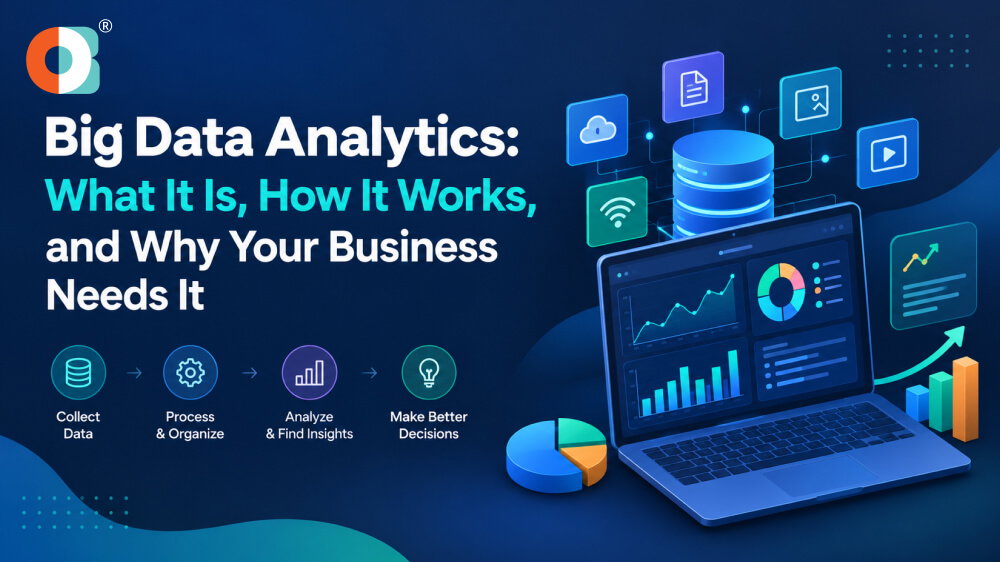
Big Data Analytics: What It Is, How It Works, and Why Your Business Needs It
Introduction
Growth has a weird way of making business decisions messier. Your sales team sees rising demand. Finance spots shrinking margins. Operations struggle to keep up with the orders. What’s disturbing is that everyone has data to support their opinions or views, yet none has the full picture in hand. This gap often leaves you investigating the wrong products or spending money to fix problems that never existed.
Now enters big data analytics, flipping the entire haphazard dynamic! It brings together information from across your business and examines relationships that can’t be spotted easily through individual reports. With it, you might end up uncovering that a seemingly profitable product is generating unusually high return expenses or customers acquired through a particular campaign hardly return. These findings give you something way more useful than another dashboard on your screen. You get a clearer basis to decide where to spend, what to change, and which opportunities to pursue.
Given the growing significance of big data analytics, we have prepared a detailed guide on this topic. Let’s explore what it actually means in a real-world context. We will walk you through the correct approach to using it to gain a competitive edge and discuss tips to make the investment worthwhile.
What is Big Data Analytics?
A single transaction will always reveal what products someone purchased. Now, imagine the volume in millions! You will know when the demand is likely to shift, or when buying habits can change. In simple terms, big data analytics allows you to unravel these larger patterns, which otherwise remain hidden in colossal business information pools. Whether it’s customer interactions or connected devices, you will have plenty of options to gather data from.
Traditional analytical approaches are often rooted in small, controlled datasets. But when we talk about big data analytics, you unlock a completely different approach. Whether it’s rapidly incoming information or different formats, handling the analytical process becomes effortless. From statistical modeling to data mining, you can use multiple techniques to:
- Investigate complex problems
- Forecast outcomes
- Detect anomalies
- Uncover opportunities that otherwise remain unnoticed
How Does Big Data Analytics Work?
Knowing just the big data analytics definition won’t help you utilize the approach for your business’s benefit. Instead, it’s important you at least have a brief overview of how it works in a real-world context. So, let’s have a look at it!
- Begin by gathering relevant information sets from various available sources, be it an enterprise application, an external data pool, or an IoT sensor. However, make sure it carries the required data input in sync with the targeted business process.
- Now, for storage, use either cloud data lakes or data warehouses as feasible. These are perfect for managing information at a large scale. What’s more, they also ensure that all data remains accessible for further analysis.
- Standardize formats in which data needs to be stored and processed, resolve every form of inconsistency, and assess data quality. By doing so, you can at least ensure that the results won't be at risk of getting skewed.
- Now integrate useful outputs into your business’s operational decisions, which can be rerouting vehicles, adjusting delivery ETAs, or scheduling predictive maintenance for factory equipment.
Types of Big Data Analytics
Descriptive analytics
If knowing where your business is performing well and where revenue and opportunity are leaking, this particular approach becomes the most feasible. Let’s consider a very hypothetical scenario where your CAC has risen by 20% over the past quarter. Descriptive analytics will help you compare data points like:
- Campaign spending
- Conversion rates
- Average order values
- Revenue across channels
Diagnostic analytics
This approach becomes quite helpful when you try but struggle with connecting different business problems together through a pattern. Suppose your profit margins have shrunk unexpectedly even when your system recorded high sales surprisingly. In such cases, you can use this big data analytics approach to examine key aspects like:
- Discounts
- Product returns
- Supplier costs
- Order fulfilment costs
Once you can identify the hidden relationship, it will become much easier for you to revise the pricing tier or renegotiate supplier terms as and when required. Here’s a catch though! Your business value will stem from directing budget towards the attributes that actually affect your profit margin.
Predictive big data analytics
With this, anticipating business risks and hidden opportunities before your finances get hit becomes much easier. For instance, if subscription is your primary revenue channel, you can use the analytical results to find frictions in:
- Login frequency
- Feature usage
- Support interactions
- Renewal history
This means that your team can focus on at-risk accounts and intervene at the right time, instead of considering every customer equally. Only by doing so can you retain users who may have left otherwise. The result? You protect your business’s recurring revenue source and cut down the need to replace lost customers through expensive acquisition campaigns. But before you plan for this approach, do explore the impacts predictive analysis can have across different industries and use cases.
Prescriptive big data analytics
There are times when you struggle with allocating limited resources or improving a specific business metric. It is then this approach becomes the apt choice. Suppose your eCommerce company has to choose between faster shipping, high order volumes, and lower delivery costs. All these are intertwined with one another, which means treating them in silos will cause more damage. Rather, you can design an optimization model to compare:
- Delivery routes
- Warehouse capacity
- Carrier rates
- Promised delivery windows
Key Technologies Used in Big Data Analytics
The tech stack isn’t something you can cherry-pick randomly. Instead, you have to be more cautious about what you want to achieve with big data analytics. That’s because these technologies will directly affect data extraction, infrastructure requirements, and maintenance costs for each component. Each tool in the stack will serve a completely different purpose, whether it’s storing decades of customer records or detecting suspicious transactions in runtime.
Having said that, here’s the list of primary technologies that fuel big data analytics at an organizational level.
- Apache Hadoop to distribute colossal datasets across multiple systems, making it easier for you to store and process extensive historical information pool
- Apache Spark to handle large-scale data processing and ML workloads, allowing your business to analyze transactions or refresh demand forecasts efficiently
- Azure or AWS can offer scalable storage and computing resources without forcing you to maintain the entire underlying infrastructure
- To keep information pieces organized in standardized formats for future reporting tasks, go with data warehouses available in the market
- To stream data pipelines and real-time analysis for immediate responses, leverage Apache Kafka and Apache Flink
What Benefits Big Data Analytics Bring For Businesses?
Make More Profitable Business Decisions
Even when your revenue climbs, it isn’t necessary that the profit will also follow the same path. Big data analytics play a crucial role here by helping you connect sales figures with the costs behind them. The results will unravel which exact products or customer segments actually contribute to your margins. What’s more, you can make accurate and more informed investment decisions. No more worries about spending millions on a growth strategy that can never yield the expected financial return.
Amplify Operational Efficiency and Minimize Costs
There’s no doubt that even the slightest form of inefficiency can silently drain your budget even when your business appears to run smoothly on paper. Big data analytics, here, can help you identify areas where workflows take longer than expected, or resources remain underused. Once you address these bottlenecks, it automatically becomes easier to control operational expenses. What’s more, you won’t have to increase headcount or sacrifice service quality by any means.
Forecast Demand and Manage Inventory
When you have wrong future demand estimates in hand, you often need to make an expensive choice between missed sales opportunities and excessive stocks. Here, what you can do is leverage big data analytics to improve forecasting and its accuracy for major SKUs sitting in your inventory. From historical purchasing trends to emerging demand patterns and seasonal shifts, you will gain numerous insights from the analytical model. These can then be used to:
- Adjust stock replenishment schedules, especially the automated ones
- Reduce locked capital in slow-moving inventory
- Maintain appropriate stock availability during peak demand cycles
Detect Fraud and Minimize Business Risks
The moment thousands of ordinary transactions carry suspicious activities, your business is at risk of fraud. Thus, you can use this analytical approach to identify different forms of unusual combinations of:
- Transaction amounts
- Locations
- Account behavior
- Payment frequency
When you handle digital payments through your platform, detecting these suspicious behaviors from day one can minimize monetary setbacks. At the same time, your security team can pay undivided attention to compliance or internal governance.
Personalize Marketing and Enhanced Retention
There’s no point of spending thousands of dollars on marketing campaigns that won’t help you acquire meaningful prospects. If you are struggling to understand how to make messaging or offers resonate with your target audience, big data analytics will be the smartest approach here. It will help you flag declining engagement among existing customers with highest accuracy.
Industries Leveraging Big Data Analytics
When you are running a business, the way you can put this to use will vary with the industry. Take retail, for example. Here, you can analyze buying patterns to anticipate future demand, especially during festive seasons, and prevent capital lock-in in SKUs that hardly reach the sales counter. On the contrary, if you operate in the finance sector, studying transaction data will assist you in flagging suspicious payments before they could turn into major losses.
In healthcare, big data analytics can help professionals study patient records with utmost precision. The insights can further support treatment planning and resource allocation, which otherwise won’t be possible with traditional analytical approaches. For a manufacturing business, however, equipment and sensor datasets reveal early failure signs. You can then schedule predictive maintenance quickly and prevent sudden stoppages or production line failures.
The catch here is every industry has its own way of putting this approach in use. What suits for a retail commerce business won’t be practical for a fintech enterprise.
Challenges in Implementing Big Data Analytics
Getting this advanced analytical method to deliver the exact business value you want isn’t always a walk in the park. The real challenge emerges when you move ahead and attempt to build a reliable system for your existing operations. So, you should know the bottlenecks that are most likely to surface in the implementation methodology or real-world use cases. Only then can you prepare yourself from day one and design a foolproof strategy for big data analytics.
- Whether it’s inaccurate sales records or incomplete customer information, poor data quality will automatically distort analytical results, leaving you with misleading findings.
- Information sitting scattered in silos across legacy enterprise systems and newer cloud lakes will be difficult to combine, further delaying implementation and driving up engineering costs disproportionately.
- The moment you want big data analytics for sensitive customer or financial information, you take up on the responsibility of restricting access, securing data, and meeting applicable regulatory needs.
- From high-end infrastructure to ongoing maintenance, the recurring expenses are often too high, way before analytics can bring in significant revenue opportunities for your business.
Best Practices for Successful Big Data Analytics Implementation
It’s only when you connect the underlying technologies to a specific business goal that you will be able to yield meaningful results, in terms of both financial investments and customer retention. So, before you proceed with the tools or infrastructure, let’s find out how you can make this journey successful.
- Begin with a defined business problem, and not a haphazard list of use cases. It can be reducing customer churn or improving inventory estimates.
- Always plan a full-scale, detailed audit of whatever data repositories you use for your business. Only then will you be able to flag quality issues and spot fragmented silos.
- Prepare a tech stack that you can later align immaculately with your analytical strategy, especially in terms of data volume, processing needs, and the next 5-year budget.
Conclusion
Your business is probably generating valuable data since day one. But most often, you fail to capitalize on it to make progressive calls. Rather, the traditional analytical approaches cause you to overlook the opportunities and drain your revenue silently. Big data analytics brings numerous benefits to the table, but only when you get it correct. Whether you want to spot profitable insights or control costs or respond smartly to market changes without making any impulsive moves, success will be defined on how efficiently and smartly you turn those numbers into a real advantage for your business in this hypercompetitive market.
Frequently Asked Questions
Think of the first as all the information your business gathers and the second as what you do with it to improve your business outcomes.
When you have to prepare an enterprise-grade tech stack for your business, you can choose from an array of tools and frameworks. However, the most popular choices across proven use cases include Apache Hadoop, Apache Spark, AWS, and TensorFlow.
It helps connect fragmented data warehouses to reveal profitable opportunities, provide proof for performance changes, forecast demand, and help allocate resources accurately for optimal utilization.
No, small and medium-scale enterprises can benefit from this advanced analytical approach easily, provided they use big data analytics for actual pain points and have enough data volume to complete the process.
From retail commerce to manufacturing, healthcare, and fintech, innumerable industries have already put this analytical approach to use for enhancing their business outcomes and deliver meaningful results.