




PostgreSQL- Complete Guide to the PostgreSQL Database, Features & Applications
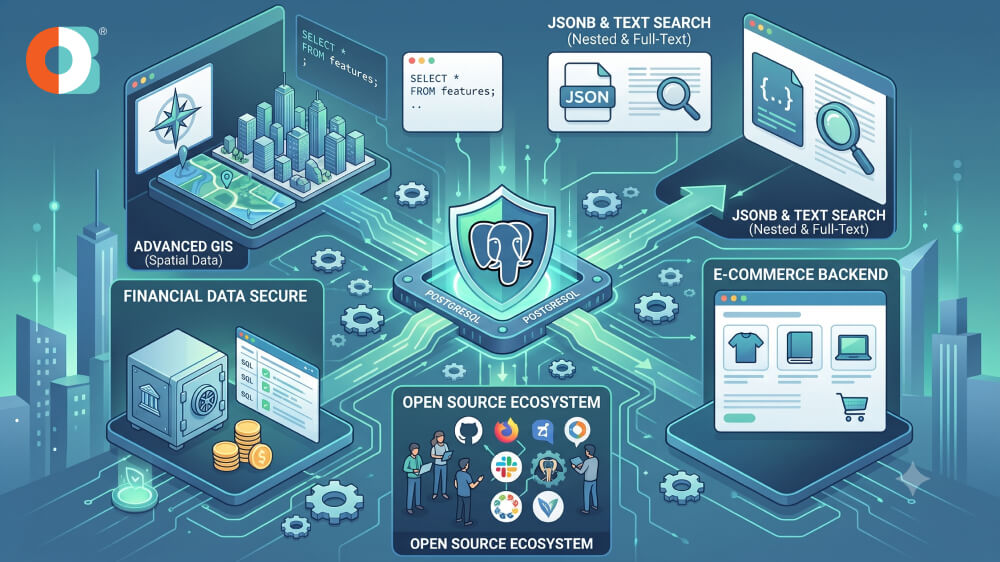
Open a job listing for almost any backend role in 2026, and there's a decent chance PostgreSQL sits somewhere in the requirements. This guide breaks down what the technology actually is, how it stores and organizes your data, and where it genuinely earns its keep in production systems today. Whether you're evaluating it for a new build or just trying to understand what your engineering team keeps talking about, this covers the essentials without the jargon.
What Is PostgreSQL?
PostgreSQL is an open-source database that is free to use. It uses structured tables that have predefined relationships with each other for storing data. The history of PostgreSQL goes back to the 1980s, when the database system was initiated by Professor Michael Stonebraker under the name Postgres at the University of California.
Later on, the developers added SQL functionality, and the project got renamed to PostgreSQL, but developers still refer to it as Postgres. Nevertheless, both names actually mean the very same thing (source).
What Does PostgreSQL Do?
Essentially, it organizes, retrieves, and manages data in a consistent manner despite multiple users working with the database at the same time.
PostgreSQL vs Postgres: Are They the Same?
Yes, "Postgres" is just another term for the same database management system. Both terms point to the exact same database system.
How Does PostgreSQL Work?
Understanding how a PostgreSQL database actually functions makes it a lot easier to make good design decisions later. The engine itself is built around a few core ideas that stay consistent whether you are running it on a laptop or a production cluster.
PostgreSQL Database Architecture
Postgres runs as a server process that manages one or more isolated databases within the same engine instance, a structure well documented in the official PostgreSQL documentation.
How PostgreSQL Stores Data
Data lives on disk in structured files, but the query planner uses indexes and caching so it rarely has to scan more than it needs to.
Tables, Rows and Columns
Like any relational system, information sits in tables made up of rows for individual records and columns for the attributes those records share.
SQL Queries in PostgreSQL
Standard SQL handles the everyday work of inserting, updating, and reading data, and Postgres adds its own extensions on top, such as window functions and common table expressions.
Client-Server Architecture
Applications connect to the Postgres server over a network socket, send their queries, and get results back, a simple pattern that scales from a single developer's machine to a multi-region deployment.
Key Features of PostgreSQL
PostgreSQL keeps topping developer surveys for a reason, and it is not marketing hype. The depth of what ships in the box, combined with how far you can extend it, is genuinely hard to match.
- ACID Compliance and Transactions: Every transaction either completes fully or rolls back entirely, which matters enormously for anything involving money or inventory.
- JSON and JSONB Support: You get relational structure and document flexibility in the same database, a combination that is one of Postgres's biggest strengths.
- Indexing and Query Optimization: B-tree, GIN, and GiST indexes speed up lookups dramatically once they are applied to the right columns.
- High Concurrency: Multi-version concurrency control lets many users read and write at once without locking each other out of the same rows.
- Geospatial Data Support: The PostGIS extension turns an ordinary Postgres install into a capable mapping and location database.
- Replication and High Availability: Streaming replication keeps a standby server ready to take over the moment the primary server has a problem.
Why Do Developers Use PostgreSQL?
Features are one thing, but adoption tells a different story. Developers keep reaching for PostgreSQL because it behaves the way they expect it to, even under real pressure, and that trust has been earned over many years.
- Reliability: Data does not silently corrupt during a crash or unexpected shutdown.
- Scalability: Good at vertical scaling, and horizontal scaling can be done using extensions such as Citus.
- Data consistency: Strict transaction handling keeps related records in sync.
- Flexibility: Support for mixed relational and JSON data without forcing any issues.
- Complex data handling: Ability to define complex relations between tables.
- Performance: Query planning and indexing keep response times low as data grows.
- Large ecosystem: ORMs, hosting providers, and monitoring tools have matured to the point where getting started takes minutes.
- Open-source advantage: With this open-source platform, you will have to pay no licensing fees and no vendor lock-in (source).
Here is a number worth sitting with. In the 2025 Stack Overflow Developer Survey, PostgreSQL was used by roughly 55.6 percent of professional developers, up from 48.7 percent the year before, overtaking MySQL for the first time. That shows how it is becoming the default choice for new projects.
Understanding PostgreSQL Database Structure
Every PostgreSQL database is organized in a clear hierarchy, and understanding it makes everything else about the system easier to reason about. A database contains one or more schemas, which act like folders grouping related tables.
Each table holds columns with defined data types and rows representing individual records. Indexes speed up lookups on specific columns; views save reusable queries as if they were tables. Lastly, functions let you package logic directly inside the database for consistent enforcement across every application that connects to it.
PostgreSQL Data Types
Choosing the right data type keeps a Postgres database fast and storage-efficient. So, it's worth knowing the basics before designing a schema.
| Category | Common Types | Typical Use |
|---|---|---|
| Numeric | INTEGER, NUMERIC, SERIAL | Counts, prices, IDs |
| Text | VARCHAR, TEXT | Names, descriptions |
| Date/Time | DATE, TIMESTAMP | Order dates, logs |
| JSON | JSON, JSONB | Flexible, semi-structured data |
| Other | UUID, BOOLEAN, ARRAY | Unique keys, flags, lists |
Applications of PostgreSQL
The real-world applications of PostgreSQL span nearly every industry that handles structured data at scale, and one recent example makes the case well. In 2025, the retail-tech company Boozt moved its finance system from MySQL to PostgreSQL, reducing invoice-approval processing times to milliseconds and decreasing the storage size from 2.5 TB to 364 GB (source). Apart from retail, the other prominently known applications of this database are:
- Web Applications: Dynamic content and transactional data for systems receiving millions of requests per day.
- E-Commerce Platforms: The inventory, orders, and payment data where there is no place for mistakes during payment.
- SaaS Applications: Multi-tenancy schemas and row-level security allow storing multiple customers' data in one database.
- Geospatial Applications: The PostGIS extension allows mapping and routing tasks.
PostgreSQL for Web and Mobile Applications
As a backend, PostgreSQL sits behind the API layer that a website or mobile app talks to, handling everything from user authentication records to product catalogs and search history. It fits cloud-based applications particularly well, since every major cloud provider now offers managed PostgreSQL, removing the operational burden of patching and backups. If you're deciding on infrastructure for a new build, this guide on choosing the right database for mobile apps walks through how PostgreSQL stacks up against other options for app backends specifically.
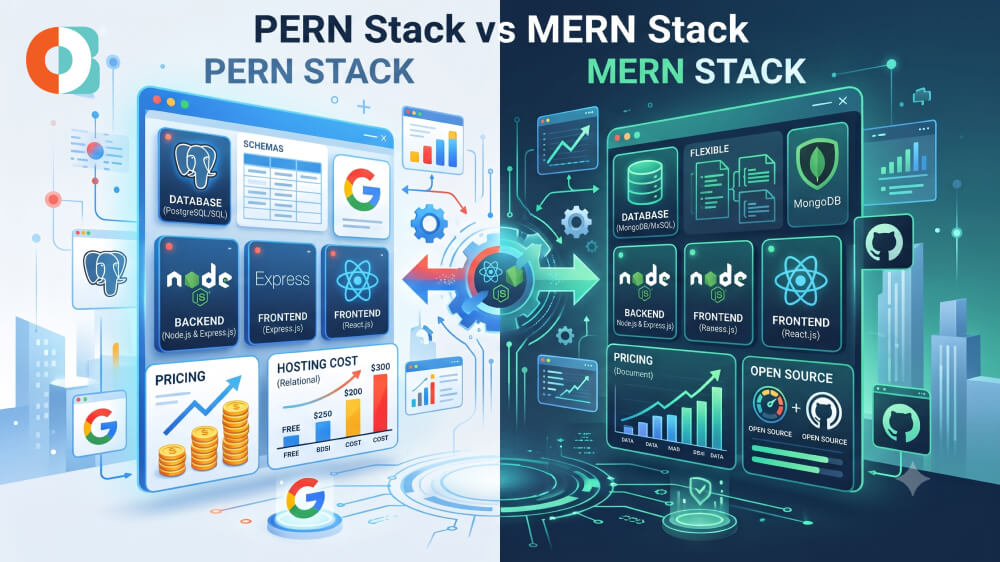
PostgreSQL in the PERN Stack
PERN stands for PostgreSQL, Express.js, React, and Node.js, a full-stack JavaScript combination that swaps MongoDB in the more familiar MERN stack for a relational database. Here, PostgreSQL handles all persistent data storage while Express and Node.js manage the backend API and React renders the frontend.
That relational foundation is exactly why PERN suits applications with real data relationships, like orders tied to customers tied to products, where a document model would take extra work to keep consistent. Teams weighing MERN against PERN for a new project should base the call on their data's actual shape, not just familiarity.
Additional Read: PERN Stack vs MERN Stack
PostgreSQL vs MongoDB and Other Databases?
PostgreSQL stands out from MongoDB and other databases. Differences among these popular databases can be understood briefly from the following table:
| Database | Model | Best Suited For |
|---|---|---|
| PostgreSQL | Relational, SQL | Complex relationships, transactions, reporting |
| MongoDB | Document, NoSQL | Changing structures, unstructured data |
| MySQL | Relational, SQL | Simpler web apps |
| SQL Server | Relational, SQL | Microsoft environment |
Advantages, Limitations, and When to Use PostgreSQL
If you think logically, every database has its positives and negatives. This is exactly why being open and transparent about the advantages and limitations of a given system gives it more credibility. Here is an overview of the strengths of PostgreSQL and things to be aware of.
Advantages of PostgreSQL
- Free and open-source database
- Robust under heavy loads
- Includes many useful features out-of-the-box
- Guaranteed data integrity
- Extensible with custom data types and extensions
- Supports some of the most comprehensive SQL dialects out there
Limitations of PostgreSQL
- May need some tuning even for trivial tasks when compared to simpler databases
- Scaling horizontally requires more tools when compared to native solutions
- Performance depends greatly on indexing
When Should You Use PostgreSQL?
Choosing the right database up front saves a lot of pain later, so it is worth being deliberate about when PostgreSQL actually fits. These are the situations where it tends to be the strongest choice.
- Applications with relational data
- Complex queries across multiple tables
- Transaction-heavy systems
- Applications requiring strong data integrity
- Applications combining relational and JSON data
- Scalable enterprise applications
When PostgreSQL May Not Be the Best Choice
If your data is extremely simple, changes shape constantly, and does not need strong consistency, a document database might get you moving faster in the short term.
PostgreSQL for Modern Application Development
Modern software rarely looks like a single monolithic app anymore, and PostgreSQL has kept pace with that shift well. It shows up as a dependable data layer for the developers working across nearly every kind of digital architecture including;
- APIs
- Microservices
- Cloud applications
- SaaS platforms
- Full-stack applications
- Mobile backends
- Enterprise applications
Using PostgreSQL in Web and Mobile Applications
Whichever type of product you are building, PostgreSQL tends to slot in as the database layer that teams do not have to think twice about. Its practical extension ecosystem makes it suitable for web and mobile applications equally well.
- Web applications
- Mobile application backends
- Full-stack applications
- Enterprise applications
- Custom software solutions
However, you will need the support and vision of an experienced website development company in India to get through the hurdles easily.
Build Scalable Applications with the Right Database
Choosing a database is rarely a standalone decision, since it shapes how the rest of an application gets built, scaled, and maintained. PostgreSQL's mix of reliability, flexibility, and open-source economics is exactly why it keeps showing up as the backbone of everything from early-stage products to enterprise platforms.
If you are mapping out the technology stack for a new build, it is worth getting the database layer right from day one. Teams offering custom web application development often start precisely here, matching the database to the data model before a single screen gets designed, since that early decision tends to save the most rework down the line.
Frequently Asked Questions
It is an open-source, object-relational database used to store and manage structured data reliably.
It simply refers to a database instance running on PostgreSQL, the terms are interchangeable.
It is basically a SQL relational database but also includes NoSQL capabilities in terms of storing JSON data via JSONB type.
Yes, all major web application frameworks support it directly, and its reliability suits everything from small sites to large platforms.
Because it gives a JavaScript-based full-stack setup a mature, transaction-safe relational database without leaving the Node.js ecosystem.
.jpg)