







PERN Stack vs MERN Stack: Which One Should You Choose in 2026?
PostgreSQL is now the most-used database among professional developers worldwide, with 58.2 percent adoption, and has been ranked the most admired and most wanted database for three consecutive years. That single statistic explains why the PERN stack vs MERN stack decision has become more relevant than ever heading into 2026.
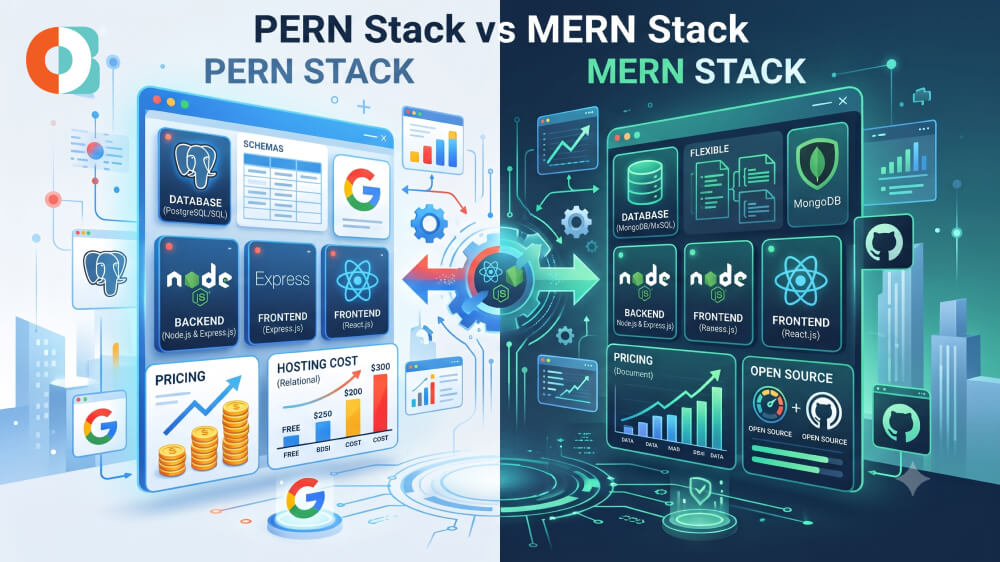
MERN and PERN sound almost identical. Therefore, you need to understand the real distinction between them, which lies in one component: the database. MongoDB powers MERN with a flexible, document-based model; PostgreSQL powers PERN with a structured, relational one. That single difference shapes how an application stores data, scales under load, and holds up as business logic grows more complex.
This guide breaks down both stacks in detail, compares them across the factors that actually influence project outcomes, and outlines which one fits different types of applications, so you can make an informed decision rather than a default one.
What is the PERN Stack?
PERN is an acronym for PostgreSQL, Express.js, React, and Node.js, a full JavaScript-based stack built around a relational database rather than a document-based one.
PostgreSQL is an object-relational database that has been around since 1996 and has only gotten stronger with time. It stores data in organized tables with clear relationships. It is fully ACID-compliant, meaning that all transactions remain consistent, isolated, and durable. That reliability is exactly why so many companies use it for things like payment processing, appointment scheduling, and inventory tracking where a small data error simply isn’t an option.
Express.js also allows you to manage backend routing and server logic, React builds the interactive user interface, and Node.js runs the entire server-side environment in JavaScript. According to the same 2025 developer survey, Node.js and React remain the most widely used backend runtime and frontend library in the industry, used by 49.1 percent and 46.9 percent of professional developers, respectively, so teams building on PERN use tools that already dominate production environments.
Teams pairing Node.js development on the backend with a relational database that behaves predictably at scale typically land on PERN when data accuracy is a higher priority than schema flexibility.
What is the MERN Stack?
MERN is an acronym for MongoDB, Express.js, React, and Node.js, and it’s probably the JavaScript stack you’ve heard of the most. Part of that is how MongoDB fits in with JavaScript itself. MongoDB stores records as JSON-like documents, not rows and columns.
This naturally matches the way JavaScript already thinks about data. This removes the overall need to define a rigid schema before development begins. This makes it an excellent option to adjust the data model as a product evolves, which is a major reason so many startups and early-stage products default to MERN. The Express.js layer and the React frontend behave exactly as they do in PERN; the only structural difference is where and how the data is stored.
Products with a heavier frontend workload often pair MongoDB's flexible storage with React JS development for the interface layer, since both technologies favor rapid iteration over rigid structure.
MERN is also the foundation behind most publicly available tutorials, boilerplates, and open-source starter kits, which gives it a documentation advantage for teams just getting started. That head start, however, does not automatically translate into easier long-term maintenance once an application's data becomes more interconnected and relationship-heavy.
PERN stack vs MERN stack: Key Differences
Once you set aside the shared middle layer, you may get a clear idea from the comparison table and get to know how each stack handles data structure, consistency, complex relationships, security, and long-term scalability.
- Data model: PostgreSQL requires a schema and shows the relevant connections between tables. MongoDB, on the other hand, allows flexibility and allows you to store documents without a predefined structure.
- Consistency: PostgreSQL guarantees ACID transactions, so both the financial and inventory records won’t end up in a partially updated state. MongoDB typically chooses greater flexibility over strict consistency.
- Complex relationships: Applications that need a seamless connection across multiple related tables customers, orders, invoices are handled natively in PostgreSQL. MongoDB, on the other hand, can model relationships too, but it typically requires restructuring data or writing additional application-side logic.
- Security architecture: PostgreSQL offers row-level security and role-based access control at the database level. MongoDB’s security model is more reliant on driver and application configuration.
- Speed of iteration: MongoDB's schema-optional design lets small teams change direction quickly during early development, which is part of why it remains common for MVPs and proof-of-concept builds.
- Ecosystem maturity: PostgreSQL benefits from almost three decades of tooling, such as replication strategies, query optimizers, and extensions, refined by a large enterprise user base.
The backend layer itself does not change this comparison much, since Express JS development runs identically on top of Node.js in both stacks; routing, middleware, and API design stay the same regardless of which database sits underneath.
Raw performance rarely decides this comparison on its own. A properly indexed PostgreSQL database and a well-modeled MongoDB collection will both perform adequately for the large majority of applications. The real difference tends to surface later, in how much rework is required to support a new feature that depends on relationships the original schema never anticipated.
Pros and Cons of PERN stack vs MERN stack
The table below compares both stacks based on multiple key factors that most commonly influence this decision in production environments:
| Key Aspects | MERN Stack | PERN Stack |
|---|---|---|
| Database | MongoDB, NoSQL, document-based | PostgreSQL, relational, table-based |
| Data Structure | Flexible JSON-like documents; schema is optional and can evolve without migrations | Structured rows and columns with a defined schema and enforced relationships |
| Data Integrity | Eventual consistency by default; strict validation must be built at the application layer | Full ACID compliance enforced at the database layer, including multi-table transactions |
| Best Suited For | Content platforms, social applications, MVPs, and products with data models that change frequently | Fintech, e-commerce, healthcare records, booking engines, and other transaction-heavy systems |
| Scalability Pattern | Scales horizontally with ease across distributed, sharded clusters | Scales vertically very well; horizontal scaling is possible but needs more deliberate planning |
| Security | Role-based access control and field-level encryption, with security largely enforced in the application layer | Row-level security, granular role-based permissions, and mature auditing built into the database |
| Typical Pros | Fast to prototype, flexible schema, natural fit for JSON-heavy applications | Strong data accuracy, reliable relationships between records, proven long-term stability |
| Typical Cons | Higher risk of data duplication and weaker native support for complex relationships | Schema changes require migrations, and initial setup takes marginally more planning |
Which Stack is Right for Your Project?
The right choice depends on the shape of your data and your product's trajectory, not on which stack happens to be trending. Below are some practical scenarios to make the decision easier:
- PERN is the right choice for you if you are building a fintech application, an e-commerce platform, a booking system, or any product where it is critical that transactions, reporting accuracy, or relationships between records are always reliable.
- Choose MERN if you are developing an advanced content-driven platform, a social application, a real-time messaging tool, or even an early-stage MVP. MERN is a good option for such projects because the data model here can be changed easily.
- Factor in your team's existing expertise. A team fluent in SQL and relational modeling will move faster on PERN, even if MERN appears simpler on the surface.
- Weigh your reporting requirements. If dashboards, financial summaries, or administrative analytics are considered the core to the product, PostgreSQL's native query capabilities often remove the need to build that logic separately.
- This is also not always a permanent, either-or decision. Some engineering teams run PostgreSQL for core transactional data while using MongoDB alongside it for logs, activity feeds, or content that does not require strict structure. The stack chosen should match the shape of the data today, without closing off options as the product matures.
For teams weighing this decision on an active project, working through the trade-offs with developers who have shipped production applications on both stacks tends to produce a more reliable answer than a generic comparison. Agencies offering dedicated MERN stack development work with both databases regularly and can assess a project against its actual data model rather than against whichever stack happens to be trending.
Since the frontend and backend layers are identical across PERN and MERN, the more consequential hiring decision is often finding full-stack developers with genuine experience in both relational and document-based data modeling, rather than developers tied to one stack by habit.
Conclusion
PERN and MERN are not two competing philosophies; rather, they are two different aspects of the same JavaScript-first approach to building web applications, separated by a single decision: relational or document-based data. PERN provides the structure and reliability of PostgreSQL, which pays off directly in applications built around transactions, reporting, and interconnected records. MERN provides the flexibility of MongoDB, which pays off when a product's data model is still taking shape.
There is no universal winner in the PERN stack vs MERN stack comparison, only the stack that fits what is being built and where the product is headed. Reviewing the actual data can allow you to make the right choice, and you can proceed to build the applications that can be scaled smoothly later if required.


.jpg)