










How Much Does Website Development Cost in India in 2026? A Complete Pricing Guide
If you're budgeting for a new site this year, the website development cost in India in 2026 is probably the first number you're trying to confirm. But the fact is, knowing the exact price is also the hardest one to get a straight answer on. Ask three agencies for a quote, and you might get three very different figures back, not because they are giving you a predicted price, but because “a website” means different things to different vendors.
A single-page landing page and a custom client portal both fall under that label, yet they call for entirely different budgets, timelines, and teams. This guide breaks down what actually drives the website development cost in India in 2026, what a realistic budget looks like across project types, certain hidden costs that you must be aware of and why India is still the leading country to hire website developers for different project types.
Factors That Affect Website Development Cost in India
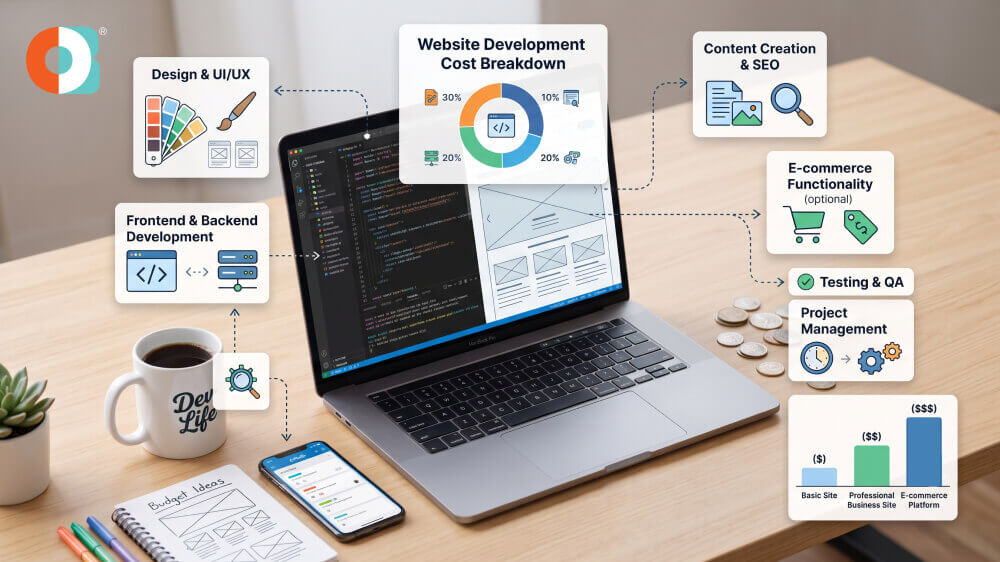
Website type and purpose, design approach, technology stack, etc., are multiple factors that actually affect the website development cost in India. Here's what typically shapes a project's final price.
1. Website type and purpose
An informational brochure site, a lead-generation page, an online store, and a custom web application sit on completely different cost curves, since each needs different backend logic and testing.
2. Design approach
A pre-built theme customised with your branding costs a fraction of a fully custom UI/UX built from wireframes and real user research.
3. Page count and content volume
More templates, more content blocks, and more unique layouts add development hours even when the underlying technology doesn't change.
4. Technology stack
WordPress, Shopify, or Webflow builds are generally faster and cheaper than custom builds on React or Node.js, which are priced for flexibility and scale over the long-term. Take a quick look at current web design trends before you lock in a stack if you’re weighing platforms.
5. Integrations
Payment gateways, CRM systems, booking engines, and third-party APIs each add development and QA time.
6. Vendor type
Freelancers, boutique studios, and established agencies price identical scope very differently based on overhead, process, and accountability.
7. Post-launch scope
Cross-browser testing, mobile responsiveness, accessibility checks, and performance optimisation are part of a professional build, not an afterthought, and they show up in the quote whether or not they're spelled out upfront.
Average Website Development Cost in India (2026): Pricing by Project Type
Based on current project scopes across Indian agencies, here's a realistic breakdown of website development cost in India in 2026:
| Website Type | Typical Cost Range | Typical Timeline |
|---|---|---|
| Single-page or landing site | ₹15,000 - ₹40,000 | 1-2 weeks |
| Business or corporate website (5-10 pages) | ₹40,000 - ₹1,50,000 | 3-5 weeks |
| E-commerce store | ₹1,50,000 - ₹5,00,000 | 6-10 weeks |
| Custom web application or client portal | ₹3,00,000 - ₹15,00,000+ | 10-20 weeks |
Note: These numbers actually cover design, development, and standard testing. They don't include hosting, ongoing maintenance, or marketing, which we'll get to next. If you're comparing markets before deciding where to build, checking the cost to build a WordPress website might provide you with a clear insight.
You will normally be working on a fixed project price, or an hourly or milestone rate. A good fit for fixed pricing is when the scope is stable and well documented; think a standard business website or a template-based store. Hourly or milestone billing is great for projects where requirements are expected to change mid-build. This is happening more often now that AI features and third-party integrations often get added after the kickoff call, not before it.
Hidden Costs Most Website Quotes Leave Out
The development quote is rarely the full cost of owning a website. Budget for these before you sign anything:
- Domain registration and renewal, roughly ₹800-₹2,000 a year, easy to forget after the first invoice.
- Shared hosting may cost around ₹2,500-₹8,000 a year. Cloud hosting is more expensive, but you pay for what you use.
- SSL certificates and ongoing security checks may cost extra.
- Premium licenses for plugins, themes, or apps, especially common on WordPress or Shopify builds.
- Content production. Professional copywriting and photography are usually billed separately from development.
- Third-party fees include monthly charges, CRM subscriptions, and API usage that recur monthly.
- Post-launch maintenance, where the development team needs to work on bug fixes, updates, and backups. Skipping this is the most common reason sites break down within the first year.
- SEO and digital marketing. A website generates no traffic on its own.
- Asking for these costs upfront, rather than discovering them after signing, is the simplest way to keep a project within budget.
Why India Remains a Cost-Effective Web Development Destination in 2026
India's position as a go-to sourcing destination isn't new, but the value case has only sharpened heading into 2026.
- Cost differential: Similar talent in India usually costs 60-70% less than in the US or UK. In India, full-stack development hourly rates are $25-$60 versus $80-$180 for similar talent in the US.
- Depth of talent: A huge pool of English-speaking developers trained on the same frameworks used worldwide, such as React, Node.js, and WordPress, means Indian teams can deliver on par with the rest of the world, not just underprice it.
- Platform expertise at scale: WordPress alone still powers roughly 42-43% of all websites globally in 2026, and Indian teams have built a correspondingly large share of that ecosystem.
- A maturing industry behind the price tag: NASSCOM's Annual Strategic Review 2026 projects India's tech industry revenue at $315.4 billion for the year, a sign of how deep and structured the delivery ecosystem really is, not a cottage industry running on cheap labour alone.
- Workable time-zone overlap: Distributed delivery gives US, UK, and Australian clients real-time collaboration windows during their own business hours, not just async handoffs.
None of this means every vendor in India delivers the same quality for the same price. It means the ceiling on what's achievable at a given budget is higher here than in most other outsourcing markets, provided you're vetting the vendor rather than just the quote.
How to Get the Best Value for Your Budget
- Cost control comes from process, not from chasing the lowest quote.
- Document your scope before requesting quotes. Vague requirements are the single biggest cause of mid-project cost creep.
- Match the billing model to the project. Use fixed pricing for a defined scope, and milestone billing when requirements are likely to shift.
- Evaluate portfolio relevance over price per page. A vendor with direct experience in your industry usually needs fewer revision cycles, which lowers the real cost even at a higher quote.
- If you're weighing an in-house hire against an agency, our guide on how to hire full-stack developers walks through what to look for beyond the resume.
- Ask for the total cost of ownership, not just the build quote. First-year hosting, maintenance, and support should be itemised separately.
- Avoid vendor lock-in. You should receive the source code, content, design files, and credentials once the project is done.
The Bottom Line
Website development cost in India in 2026 is ultimately a function of scope. A Rs. 30,000 landing page and a Rs. 10,00,000 web application are both technically “a website,” but they solve entirely different business problems, and no single number applies to both. Businesses that get the best budget for hosting, maintenance, and marketing, along with the best team to build it, are likely to proceed with the website development project with them.
Owebest's website development team in India works across these budget tiers, from focused five-page business sites to custom e-commerce platforms and enterprise web applications, and can walk you through a realistic budget for your specific scope before you commit to a vendor.
.jpg)
.jpg)