











NestJS vs NextJS — Key Differences and Which One to Choose in 2026
The framework you choose today will be the ultimate determinant of your product’s ability to handle its next million users, features, and integrations. Pick the right one, and scaling will become the smoothest journey. Choose the wrong framework, and you will have a costly rebuild in hand. That’s exactly why the NestJS vs NextJS decision shouldn’t just be grounded in a quick feature comparison.
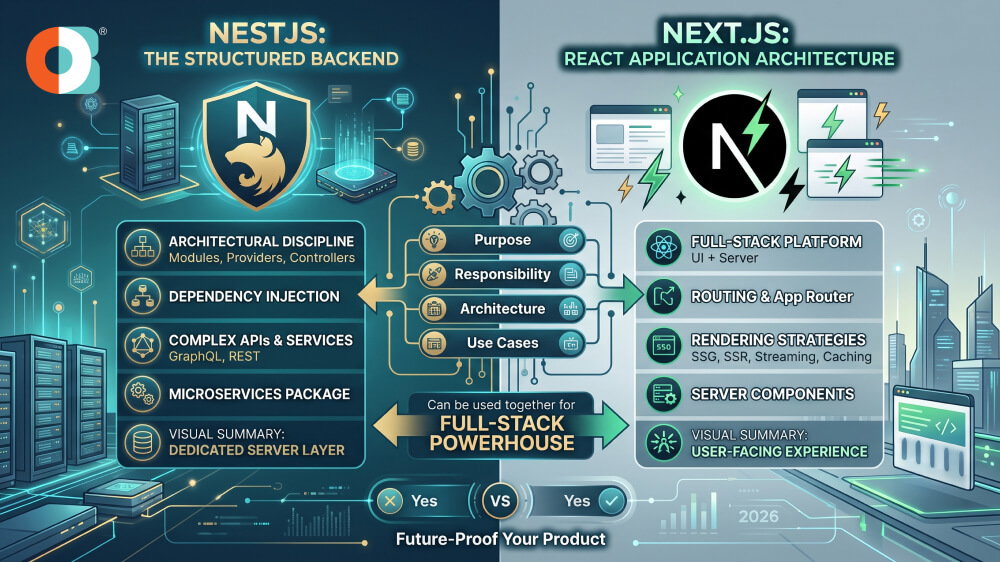
NestJS is rooted in structured backend development. That’s why you can easily use it for authentication, APIs, microservices, and integration-laden systems. Next.js, meanwhile, offers a blend of React-driven frontend and server-side rendering, routing, and backend capabilities. The fine line between these two blurs out further as modern frameworks now do not rely on separate layers.
Whether you are a startup choosing your stack for the MVP or an established organization rebuilding a customer-facing platform, your attention should transcend the framework’s popularity. In this guide, we will walk you through the fundamental differences between both these frameworks. So, by the time you will reach the end, you can easily establish the fine line of difference in relation to scalability, performance, use cases, and long-term maintainability.
What is NestJS?
When we talk about Node, it’s flexibility is one of the many reasons why most development projects have it included in the stack. However, it is this same ability that ultimately takes the shape of a liability once the backend grows beyond a handful of routes and services. NestJS brings architectural discipline to that ecosystem. Built with TypeScript, it offers a consistent way to segregate server-side code into modules, providers, and controllers. The working principle of these components is further rooted in dependency injection logic.
This is what helps create clearer boundaries between application logic, request handling, and shared services. Thus, you won’t have to follow the same implementation technique for your project. What’s more, NestJS runs on Express by default, while supporting Fastify at the same time. Its architecture surprisingly extends across:
- GraphQL and REST APIs
- WebSockets
- Microservices
- Authentication
What is NextJS?
React, undoubtedly, excels at helping you build stunning interfaces. But Next.js provides an application architecture required to turn those UIs into a complete web experience, with immersivity at its peak. With it, you no longer have to worry about handling concerns that sit around the React components themselves manually, including:
- Routing
- Rendering
- Server-side logic execution
- Data fetching
- Delivery
You have the App Router module, which automatically allows Server and Client components to coexist within the same ecosystem. Thus, you can retain computation and data access on the server while executing interactive elements in the browser. In addition, this framework also gives you control over how different parts of an application are produced and delivered by supporting:
- Static generation
- Dynamic rendering
- Streaming
- Caching
NestJS vs NextJS — Core Purpose
The clearest answer to NestJS vs NextJS ultimately comes down to the purpose for which the framework has been built in exact. While the former is grounded to the server and application layer, the latter is rooted to the web application and user-facing layer.
| Feature | NestJS | Next.js |
|---|---|---|
| Primary purpose | Building structured backend applications and APIs | Building React-based web applications |
| Core environment | Node.js + TypeScript | React + TypeScript/JavaScript |
| Main responsibility | Application logic, APIs, services, integrations, backend architecture | UI, routing, rendering, data fetching, and server-side web functionality |
| Architecture | Modules, controllers, providers, dependency injection | App Router, Server Components, Client Components, layouts and route segments |
| Typical role | Dedicated backend | Full-stack web application framework |
| Best suited to | Complex APIs, microservices, real-time systems, integration-heavy backends | SaaS interfaces, ecommerce, content platforms, dashboards, customer-facing applications |
NestJS vs NextJS — Detailed Comparison
Architecture and Application Structure
When we talk about NestJS, you get the flexibility of organizing the server around application domains. In other words, you can use the in-built modules to keep orders, payments, users, or accounts isolated from one another. Controllers, on the other hand, expose the capabilities and providers house the logic behind them. On top of this, you can capitalize on dependency injection to connect these pieces without having to hard-wire them explicitly. Next.js, on the contrary, organizes itself around the web app’s route tree. In other words, each route has its own:
- Page
- Layout
- Loading state
- Error boundary
- Server/client execution model
Frontend and Backend Capabilities
Calling NestJS “backend” and Next.js “frontend” is indeed technically correct, but isn’t complete. NestJS owns virtually everything that sits behind the interface, including:
- Authentication
- Authorization
- Database access
- Payment processing
- Business rules
- File handling
- Queues
- Scheduled
- Integrations
But when it comes to Next.js, you get the ability to execute meaningful server-side logic. That’s because this framework comes with:
- Server Components for accessing server-side resources
- Server Actions to handle mutations
- Route Handlers to expose HTTP endpoints
It’s due to these abilities that Next.js has become a full-stack platform, and not just a React frontend.
Rendering and Data Fetching
It is here that Next.js triumphs over NestJS, as it can control the entire journey from server-rendered data to browser-rendered interaction. Thanks to the App Router, the Server Components can easily fetch data and generate the UI on the dedicated server without sending the component code to the browser. Client Components take over the control when state, event handlers, or browser APIs are needed.
What’s more, this framework supports advanced capabilities that allow you to choose different delivery strategies for different parts of the same app, like:
- Static generation
- Dynamic rendering
- Streaming
- Caching
- Revalidation
Performance and Scalability
Neither framework will give your application a free performance advantage. That’s because they influence different bottlenecks. When you work with NestJS, performance is likely to come down to backend engineering. It includes activities like:
- Database query efficiency
- Connection pooling
- Serialization
- Asynchronous processing
- Caching
- HTTP overhead
What’s more, if you choose Fastify over Express, this framework will automatically speed up. Also, its microservice-driven abilities allow you to separate computationally distinct workloads whenever your app’s architecture demands it. But with Next.js, you get another performance layer in terms of:
- What components will be rendered
- Where will they be rendered
- How much JavaScript is likely to reach the browser
At scale, Next.js relies a lot on sound caching, data access, CDN, and infrastructure decisions.
TypeScript and React Integration
Both frameworks strongly support TypeScript. However, they use different parts of the stack. For example, NestJS uses it to bring structure to the server-side architecture of your application. DTOs describe request payloads. Decorators attach metadata. Dependency injection resolves providers. Classes represent services, repositories, and domain components.
For Next.js, TypeScript gets combined with React’s underlying component model. Here, types often travel from API responses into server components, through props and forms, and into client-side interactions.
Microservices and Distributed Systems
NestJS becomes more interesting when your application stops behaving like a tightly coupled one, all thanks to the framework’s microservices package. It supports multiple communication protocols, including:
- TCP
- Redis
- NATS
- MQTT
- RabbitMQ
- Kafka
These help the services exchange messages without making every interaction a conventional HTTP request. Next.js, on the contrary, consumes these services, but isn’t designed to be the center of the distributed backend. Its server capabilities are closely intertwined with the web app’s entire lifecycle. So, you can easily put API calls, mutations, and server-side logic directly inside a Next.js project.
Also Read: Website Development Company in India
Pros and Cons of NestJS vs NextJS
NextJS framework
Pros
- A single codebase can carry the UI and server-side together cohesively, thereby removing the coordination layer completely for apps whose backend requirements greatly revolve around web experience.
- Rendering isn’t locked to one strategy. Dynamic rendering, static generation, caching, revalidation, and streaming can coexist across different routes without forcing you to fit the entire app into a single delivery model.
- The App Router makes the route tree an architectural tool. Layouts persist across navigation. Loading and error boundaries often sit close to the routes they govern. UI composition also follows the app’s URL structure.
- As Next.js sits on top of React, your team will inherit a deep ecosystem for component libraries, design systems, CMS platforms, authentication, and other types of web-facing capabilities.
- With Server Components, you can easily shift data fetching and rendering work away from the browser. This will help you reduce the number of component JS that needs to reach the client.
Cons
- With server responsibilities growing into complex domains, keeping everything inside your web app will tend to create architectural pressure.
- The rendering model has more moving parts, which is why Server and Client components can affect the code execution.
NestJS framework
Pros
- With NestJS, you gain an architectural vocabulary for your app’s backend code. That’s because modules define boundaries, controllers handle transport concerns, and providers hold reusable application logic.
- Dependency injection completely changes the dynamics of how infrastructure gets connected to application logic.
- NestJS can sit behind event-driven architectures, thanks to the availability of transport protocols like RabbitMQ and Kafka. The result? More rooms for you to implement asynchronous service-to-service workflows.
- The backend doesn’t care whether its consumers are React, native mobile, another service, or an external partner. Thus, you can use one API layer, instead of designing separate integrations for a single interface.
- Pipes, guards, interceptors, exception filters, and middleware will give your app’s cross-cutting concerns a defined place in the request lifecycle.
Cons
- A polished web product will still need a frontend architecture, which automatically introduces another app boundary to design, deploy, and maintain.
- Its opinionated structure has a cost at the smaller end of the spectrum.
Can NestJS and NextJS Be Used Together?
Yes, absolutely. Both NestJS and NextJS can form a full-stack architecture when your application needs a dedicated backend alongside a React-driven web layer. Here, NextJS will handle:
- Interface
- Server-side rendering
- Routing
- Web-specific interactions
On the other hand, NestJS will own:
- Authentication
- Business rules
- Database access
- Background jobs
- APIs
These layers can communicate through REST, GraphQL, or any other API mechanism. What’s more, you can deploy each app layer independently of one another.
Read More - PERN Stack vs MERN Stack: Which One Should You Choose in 2026?
Which One Should You Choose?
The decision comes down to where your application’s complexity lives. Based on this criterion, choose Next.js when your primary hurdle is building an immersive web experience around React. Also, you should factor in the probability of routing, rendering, data fetching, and server-side functionality being closely connected to the UI.
On the other hand, NestJS becomes a practical choice for your tech stack when the system revolves around multiple backend concerns, like:
- Complex domain logic
- Background processing
- Shared APIs
- Multiple client applications
In case the web layer and backend require separate architectural boundaries for seamless scalability and independent rollout plans, consider including both.
Conclusion
The right framework depends on what your application must remain flexible around. Next.js brings together React, routing, rendering, and server capabilities in a single package. Conversely, NestJS offers a much stronger and more mature structure for backend-heavy systems. Hence, in the battle of NestJS vs NextJS, neither one is a clear winner here. That’s because both solve completely different architectural problems.

.jpg)
.jpg)