








Doctolib-Like App Development: Features, Tech Stack & Cost Guide

The face of healthcare appointment booking has been radically changed over the last few years, with websites such as Doctolib being on the frontline in the digitization of healthcare access in Europe. It served more than 60 million patients and 300,000 healthcare professionals, which proves the enormous power of properly implemented healthcare booking solutions.
In case of similar opportunities, Awareness of what makes Doctolib successful is a valuable source of strategic planning and investment choices to undertake in case of being a business entity or healthcare organization. It is a comprehensive guide on the features, technical architecture, and realistic budgets to develop healthcare booking apps that will bring outstanding value.
Understanding the Doctolib Success Model
Doctolib had turned a disjointed and maddening healthcare booking experience into a smooth online experience. Before websites like Doctolib, patients spent a lot of time on the phone during office hours and had difficulties locating the right specialists, whereas healthcare workers handled a booking system inefficiently, using paper-based methods.
The success of the platform can be attributed to its focus on both sides of the pain points. Patients were able to book 24/7 with providers available in real time, and healthcare professionals were provided automated booking, saving up to 40% of administrative load. This two-sided value proposition introduced network effects that led to exponential growth. Telemedicine integration further increased the adoption, and it was proven that digital healthcare infrastructure is not only convenient but it is the key to delivering healthcare in the present day.
Essential Features for Healthcare Booking Platforms
Creating similar platforms to Doctolib requires a large amount of functionality to accommodate the needs of different stakeholders.
Patient-Facing Features
The patient application should also offer intuitive experiences that eliminate the friction in healthcare access:
- Smart search and filtering according to specialty, location, insurance acceptance, availability, and ratings.
- Live availability ensures that no one is disappointed by double-booking.
- Real-time reservation confirmation powered by Google, Apple, and Outlook calendars.
- SMS, email, and push messages to remind patients and reduce the no-show rates by 30-40 percent.
- Extensive details of the provider, including qualification, specialization, review,s and office address.
Some additional features include safe access to medical history, electronically-ordered prescriptions that are delivered directly to pharmacies, and the use of wearables to track health. These functions convert the platform from basic booking tools into powerful patient interaction tools.
Practitioner Dashboard Capabilities
The healthcare providers need solid workflow management tools. Third-level calendar management enables scheduling availability, schedule-based recurring schedules, blocked time, and coordination of the providers. The patient management system contains all the profiles, including medical history, appointment records, treatment plans, and logs of secure communications.
Combined telemedicine functions have ceased to be an option and must be a necessity. In-built video consultation features, such as screen sharing, writing digital prescriptions, and built-in payment processing, make the virtual care experience complete. Practice analytics can offer information on the number of appointments, the rates of no-show, revenues, and demographics of patients, which can be used to make operational decisions based on the data.
Administrative Control Panel
The administrators of the platform require multi-location management, provider credential verification, system configuration, financial reporting with commission tracking, and compliance monitoring with complete audit trails. These back-end features enable the operators to scale efficiently and retain quality standards.
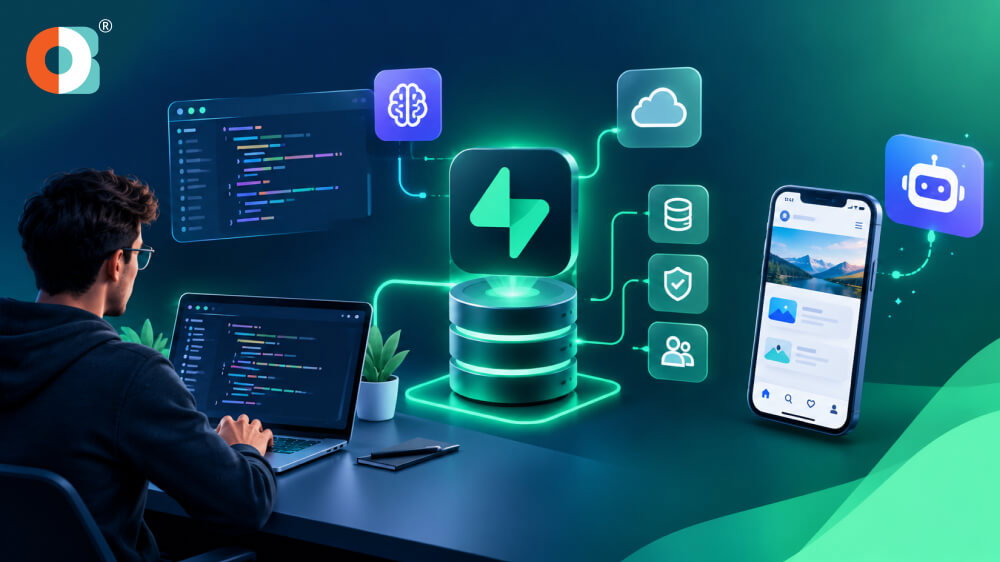
Technical Architecture and Technology Stack
The technical base defines the scalability of the platform and its sustainability.
Frontend and Mobile Development
Web applications are typically done using React or Angular framework, which is a responsive and performant interface across devices. Native iOS and Android apps written in Swift and Kotlin, respectively, offer the best performance, but React Native or Flutter are also an option to implement a faster time-to-market. The point here would be to have a consistent user experience regardless of how the patients make their bookings, be it via a web browser or a cell phone application.
Backend Infrastructure
Excellent solutions to multitasking customers and confidential medical data:
- Server configuration:
Node.js + Express to provide real-time functionality
Python + Django to use the data processing, and
Java + Spring Boot to provide enterprise stability.
- Databases:
PostgreSQL, a relational database
MongoDB, an adaptable document framework; and
Redis, an appointment slots information store.
- Live communication: WebSocket to be informed of the news right now, Twilio Video, or Agora to take a telemedicine session.
- Cloud infrastructure: AWS, Google Cloud Platform, or Azure with load balancing, auto-scaling, and CDN to provide performance at a global scale.
In explicit healthcare compliance, e.g., HIPAA in the United States and GDPR in Europe, architecture choices are sensitive with respect to data encryption, access control, audit logs, and data residency.
Development Timeline and Process
The development of healthcare booking platforms is a process. The discovery and planning may be completed in four to six weeks, which will include market research, competitive analysis, feature prioritization, and regulatory compliance planning. Intuitive user experiences are developed in six to eight weeks of design and prototyping, founded on interface design, interactive prototype, and verification of accessibility compliance.
MVP implementations, which contain the implementation of authentications, booking engines, calendar management, payment integration, and telemedicine capability, will require four to six months to complete as core development. The six to eight weeks of integration and testing will ensure the reliability of the operation, security testing, performance testing, and compliance testing. Deployment and launch take two to four weeks: Infrastructure deployment, application submission to the app store, and roll-outs.
Understanding the Cost to Build an App Like Doctolib
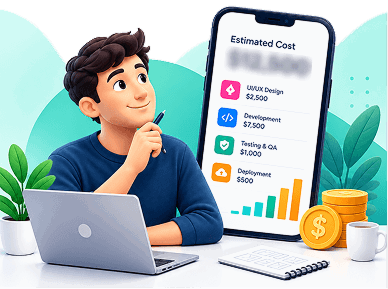
Budget planning needs a fair projection of investments in development. The cost to build app like doctolib can heavily rely on the functionality and technicality of the applications, as well as the place of the team.
Investment Tiers
Simple Healthcare Booking platform (80,000 -150,000). It will also consist of easy appointment booking, searching through providers, and basic calendar and patient profiles. Applicable to small clinics that are starting to go digital. Time: 4-6 months and groups of 4-6 developers.
Middle-Tier Platform, including Telemedicine ($150,000 to $300,000), which includes video consultation, enhanced search and payments, insurance checks, and mobile applications (iOS and Android). Represents multi-located practices or healthtech startups. Timeframe: 6-9 months, work of teams of 6-10 specialists.
Enterprise-Grade Platform (300,000 -800,000+) Includes multi-tenant architecture, AI-driven matching, built-in analytics, EHR integrations, and a white-label option. Similar to the Doctolib scale. Plan: 9-15 months and groups of 10-15 specialists.
Cost Variables
The effect of geographical location on budgets is great:
- North America/Western Europe: $100-200/hour.
- Eastern Europe: $50-$100/hour
- India: $25-$75/hour
Other uninterrupted expenses are cloud infrastructure (500-5,000 per month), third-party services (200-2,000 per month), compliance audits (10,000-30,000), and maintenance (15-20 percent of development costs a year).
Monetization Strategies
Doctolib is an example of a successful application of subscription that offers healthcare providers a monthly fee with tiered pricing depending on the number of appointments and features. Basic plans start at $50-$100 a month, the professional level at $150-$300 a month, and custom enterprise plans will be required based on the size of the network.
Other sources of income are transaction fees of 2-5% on bookings, add-ons such as premium features, such as advanced analytics or EHR integrations, and advertising opportunities with pharmaceutical or medical device companies. Other platforms may involve imposing nominal booking fees on the patients, but this must consider the adoption barriers.
Regulatory Compliance Requirements
Healthcare applications work under the most tightly controlled conditions, with strict punishment imposed on non-meeting the standards. In the United States, HIPAA compliance requires encryption of information, general access controls, business associate agreements, and breach awareness measures. In the attempt to meet the requirements of the European, there is a need to have explicit consent procedures, portability, and the transparency of privacy policies.
Its security practices are based on multi-factor authentication, role-based access controls, end-to-end encryption, regular penetration testing, and extensive disaster recovery planning. The interoperability with existing healthcare systems is guaranteed by the industry standards, such as HL7 FHIR for data exchange and the ICD-10 codes.
Key Success Factors
It is necessary to consider essential aspects when creating platforms that can be effective. User experience excellence means that there should be easy-to-use interfaces, loading time should not take more than three seconds, and accessibility. The ease of onboarding, automation to save time, and responsive service are the determinants of provider adoption. Security, visible data policy, and verified provider credentials are all elements of patient trust. Technical reliability requires 99.9 percent availability, scalability, and frequent upgrades.
Partnering with Owebest Technologies
Creating healthcare booking platforms similar to Doctolib is not like baking a cake. Without a doubt, it takes specialized competencies in the field of healthcare workflows, regulatory compliance, and technical excellence. The founders of Owebest technologies carry with them extensive experience in health care app development, having created telemedicine systems, patient management, and booking application systems in a variety of situations across the world.
CMMI Level 3 certification will guarantee the stability of quality by means of established processes. This is because our healthcare field experience is a guarantee of adherence throughout the project establishment to avoid expensive retrofitting.
We know the cost to build app like doctolib is quite a substantial investment, which is why our collaborative strategy will keep the stakeholders engaged in the development process with the aim of focusing it on the strategic vision without exceeding the budget constraints.
Taking the Next Step
The achievement of Doctolib proves the massive opportunities of healthcare booking systems, which actually address issues. The market size is large, and the booking of appointments in healthcare is a multi-billion-dollar sector that is undergoing rapid digital transformation.
To begin your journey, you need to have some intensive market validation with pinpointed pain points, regulatory guidance to help you avoid legal costs, a technical architecture layout that prevents expensive re-development, and skilled development specialists with demonstrated healthcare experience.
Marketing the development of healthcare booking platforms? Speak to Owebest Technologies and negotiate your vision, technical specifications, and budget. We can create a platform that changes the healthcare access in your market.