










How Much Does Healthcare App Development Cost in Dubai, UAE
.jpg)
Dubai's healthcare sector is moving fast, and the organisations that invested in digital infrastructure two years ago are already pulling ahead. With the Dubai Health Authority mandating electronic health records across licensed facilities, hospital groups, clinic chains, and digital health startups are now under real pressure to build or upgrade patient-facing and clinical platforms, on time and within a defensible budget.
For procurement leads, IT heads, and CFOs evaluating this investment, the hardest question is rarely "should we build?"; it's "what will this actually cost, and what are we risking if we underspend?" This guide breaks down every cost variable: scope, compliance engineering, integration complexity, and vendor selection. Learn the healthcare app development cost and build a realistic business case, and avoid the budget overruns that derail most first-time healthtech projects in the UAE.
Get a tailored cost estimate from our DHA-certified team — no commitment required.
Why Dubai Is Becoming a Strategic Hub for Latest HealthTech Development
In the Middle East's technology and commerce capital, Dubai’s position makes it an attractive launchpad for AI-powered and innovative healthtech solutions. The emirate combines advanced telecommunications infrastructure and a proactive regulatory environment under the Dubai Health Authority.
Several factors make the UAE healthtech market and healthcare app development cost structurally different from other geographies, and they directly affect your cost model:
- DHA and DOH regulatory compliance requirements add a mandatory engineering scope that non-UAE vendors routinely underestimate, often causing costly rework post-launch.
- NABIDH and Malaffi health information exchange integrations are compulsory for enterprise platforms, not optional add-ons.
- A multilingual user base (Arabic, English, Urdu, Tagalog) increases frontend and UX investment, particularly for patient-facing applications.
- Vendor quality varies significantly; choosing a partner without a documented DHA approval track record is one of the most common reasons projects stall at the compliance stage.
According to industry research, the UAE digital health market is projected to exceed $1.8 billion by 2027, driven by government-led smart health initiatives and rising enterprise adoption. For organisations in the market now, that growth window is also a competitive one — early movers are locking in platform advantages.
Healthcare App Development Cost in Dubai: Pricing Breakdown
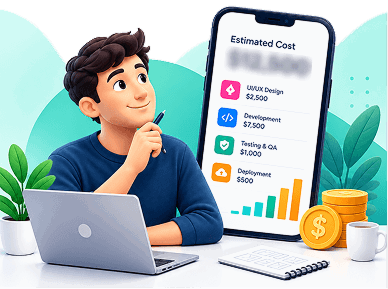
The following table provides indicative investment ranges for medical app development cost UAE in the UAE market. These figures reflect end-to-end delivery, including discovery, design, development, QA, compliance review, and initial deployment support.
| Healthcare App Type | Estimated Cost for the App (USD) | Timeline Estimate | Typical Scope |
|---|---|---|---|
| Basic MVP | The cost varies between $25,000 – $60,000 | 2 to 6 months | Single-platform, core features, minimal integrations, internal pilot |
| Mid-range Healthcare App | The cost varies between $60,000 – $150,000 | 4 to 6 months | Cross-platform, 1–2 third-party integrations, DHA compliance, limited HL7 |
| Enterprise-level Healthcare Platform | The cost varies between $150,000 – $400,000 | 6 to 9 months | Full EMR/HMS, multi-role, NABIDH/Malaffi, AI features, analytics dashboard |
| Complex-level Healthcare App | The cost may go up to $400,000+ | 9 months and sometimes 1 year to develop and finally launch the app | AI diagnostics, IoT RPM, multi-hospital, full regulatory stack, cloud infra |
Real-World Example: Multi-Specialty Clinic Telemedicine Platform
Client Case Study — UAE Multi-Specialty Clinic Group
The brief: A 6-clinic group in Dubai required a telemedicine platform with full EMR integration, DHA regulatory approval, bilingual Arabic/English UI, and a 90-day post-launch support window.
Scope delivered: Compliance engineering (DHA submission-ready architecture), HL7 FHIR integration with their existing hospital system, role-based dashboards for doctors and patients, Arabic RTL UI, and cloud infrastructure on Azure UAE North.
Budget range: $120,000 – $160,000, excluding ongoing cloud hosting and maintenance (scoped separately).
6 wks
DHA approval timeline
2
Languages supported
90 days
Post-launch support
HL7 FHIR
Integration standard
If your organisation is at a similar stage, the $120,000–$160,000 range is a reasonable starting point before your detailed discovery phase. Cloud infrastructure and ongoing maintenance are scoped separately.
Key Factors That Drive the Healthcare App Development Cost in Dubai
No two healthcare applications carry the same price tag, and there are certain variables that are the primary cost drivers for any healthcare mobile app development in Dubai.
1. Application Type and Clinical Scope
Usually, a patient-facing appointment booking app and a clinical decision support system or a modern AI-powered diagnostic tool are completely different according to their core engineering features. Furthermore, some core categories and their typical complexity tiers also include:
- Telemedicine & Virtual Care Platforms — Medium to high complexity
- Electronic Medical Record (EMR) / Hospital Management Systems — High complexity
- Remote Patient Monitoring (RPM) with IoT integration — High complexity
- Pharmacy and Prescription Management Apps — Medium complexity
- Wellness and Preventive Health Apps — Low to medium complexity
2. Regulatory Compliance Engineering
Any healthcare app handling patient data in the UAE must comply with DHA's health data protection standards. This covers data architecture decisions, audit logging, consent flows, and documentation prepared for DHA submission. In our experience, compliance engineering typically accounts for 20–35% of total development cost, and skipping or deferring it is rarely the saving it appears to be.
3. Integration Complexity
Enterprise medical app development cost UAE always requires seamless integrations with the existing hospital infrastructure. Also, the connections to laboratory systems, HL7 FHIR APIs, PACS imaging systems, and some of the latest government health portals.
For example, each major third-party integration adds $8,000–$25,000 to a project, depending on API maturity and data volume.
4. Platform Strategy
The choice between native iOS and Android development, and certain cross-platform frameworks such as Flutter, React Native, or Progressive Web Apps (PWA) directly impacts both initial investment and also the long-term maintenance cost.
Enterprise clients who usually expect a mixed iOS/Android workforce mostly favor cross-platform approaches, which typically offer almost 25 to 35% cost savings.
5. UI/UX Design and Accessibility
Healthcare applications usually demand clinical-grade UX, and it is different from traditional product pages. Furthermore, better accessibility, right-to-left Arabic language support, and proper role-based interface customization for doctors, physicians, nurses, and patients add significant value to the overall design scope.
This design scope for a mid-range healthcare application typically runs $12,000–$30,000, depending on the number of user roles and interface complexity.
Hidden Cost Factors Buyers Consistently Underestimate
The quoted development figure is rarely the final number. These line items are frequently omitted from initial vendor proposals and first-pass internal budgets:
1. NABIDH or Malaffi onboarding and certification fees
Government health exchange onboarding carries administrative and technical costs that sit outside standard development sprints. Budget $5,000–$15,000 depending on integration scope.
2. Third-party API licensing
EHR vendors, lab systems, insurance network connections, and payment gateways each carry recurring licence fees. Confirm these with vendors before finalising your TCO.
3. Security penetration testing and vulnerability assessment
Mandatory for clinical-grade apps. Typically $5,000–$20,000 per engagement, and must be repeated after major releases.
4. Cloud infrastructure setup and ongoing hosting
Azure UAE North and AWS Middle East (Bahrain) are the regional standards for data residency compliance. Budget $800–$4,000/month depending on traffic and redundancy requirements.
5. Post-launch maintenance
Typically near around 15–20% of initial development cost annually is required for the post-launch maintenance. A $150,000 project typically carries $22,500–$30,000/year in maintenance costs covering bug fixes, OS updates, security patches, and minor feature changes.
6. Staff training and change management
Clinical teams and admin staff require onboarding. This is frequently excluded from project proposals but represents real implementation cost.
Vendor Models: What You Are Actually Buying
Understanding vendor models before committing affects your total investment and risk profile significantly.
| Model | Cost Profile | DHA Risk | Best for |
|---|---|---|---|
| Local Dubai agency | 30–50% premium | Low | Regulated enterprise, tight DHA timelines |
| Offshore only (India, E. Europe) | Lowest per-sprint | High | Non-clinical apps, pre-DHA MVP |
| Hybrid model | Mid-range | Low to Medium | Mid-market enterprise, cost-sensitive |
| Dedicated healthtech studio | Mid-to-premium | Lowest | Complex clinical platforms, fast DHA approval |
For B2B buyers, the total cost of ownership calculation should extend beyond development to include ongoing support contracts, infrastructure hosting, and feature iteration budgets across a 3-year horizon.
Why to Choose Owebest Technologies for Healthcare App Development in Dubai
Before you finalize a vendor for healthtech development cost, considering certain skills and capabilities are necessary.
- DHA & DOH Certified - Documented approval track record across Dubai and Abu Dhabi
- ISO 27001 Aligned - Information security practices that meet clinical-grade standards
- NABIDH / Malaffi - Certified integration experience with the best UAE health exchanges
- HL7 FHIR Expertise - Production integrations with leading EMR and HMS vendors
Clients we've worked with include multi-specialty clinic groups, pharmacy chains, insurance platforms, and digital health startups across the UAE and GCC. View our portfolio →
Choosing the Right Partner for Healthcare Software Development
If you want to select a vendor for healthcare mobile app development Dubai, partnering with experienced Healthcare App Developers Dubai can simplify regulatory compliance, integration planning, and long-term maintenance. Consider it a strategic decision.
- Proven experience with DHA, DOH, and MOH regulatory frameworks
- HL7 FHIR and regional health exchange integration track record
- ISO 27001 or equivalent information security certification
- Transparent project governance with milestone-based billing
- Post-launch support SLAs specific to clinical applications
Closing Up
For healthcare organizations, hospital groups, insurers, and digital health startups operating in the UAE, healthtech development cost is no longer a discretionary investment; rather, a competitive and regulatory imperative.
Therefore, understanding the full spectrum and connecting to a leading partner such as OweBest Technologies would be the best decision. The experts can create the best healthcare apps, aligning your business goals and expectations within an appropriate budget. So, connect to the team and meet both your user needs and certain regulatory mandates.
FAQs
1. How Long Does a Healthcare Mobile App Take in Dubai?
The overall development timeline for a healthcare mobile app development Dubai varies based on the overall complexity:
- 3–6 months for basic apps
- 6–9 months for mid-level apps
- 9–18+ months for the enterprise-level apps
2. Do Healthcare Apps in Dubai Need DHA approval?
Yes, healthcare apps and any health-related digital platforms that provide medical services in Dubai must receive clear approval from the Dubai Health Authority (DHA).
3. How Much Does It Cost to Maintain a Healthcare App Annually in Dubai?
The annual maintenance for a healthcare app typically runs between 15–20% of the initial development cost for active platforms. If you have a plan for a $150,000 development project, the maintenance cost may rise up to $22,500–$30,000 per year, covering certain bug fixes, proper operating system updates, security patches, and minor feature changes.
Ready to Start Your Healthcare App Project?
Ready to Start Your Healthcare App Project?
We have delivered multiple DHA-approved healthcare platforms for clinic groups, hospital chains, insurers, and also digital health startups across the UAE. Whether you're planning for a first build or upgrading your existing system, we can give you a realistic estimate and compliance-ready roadmap for the healthcare app.