






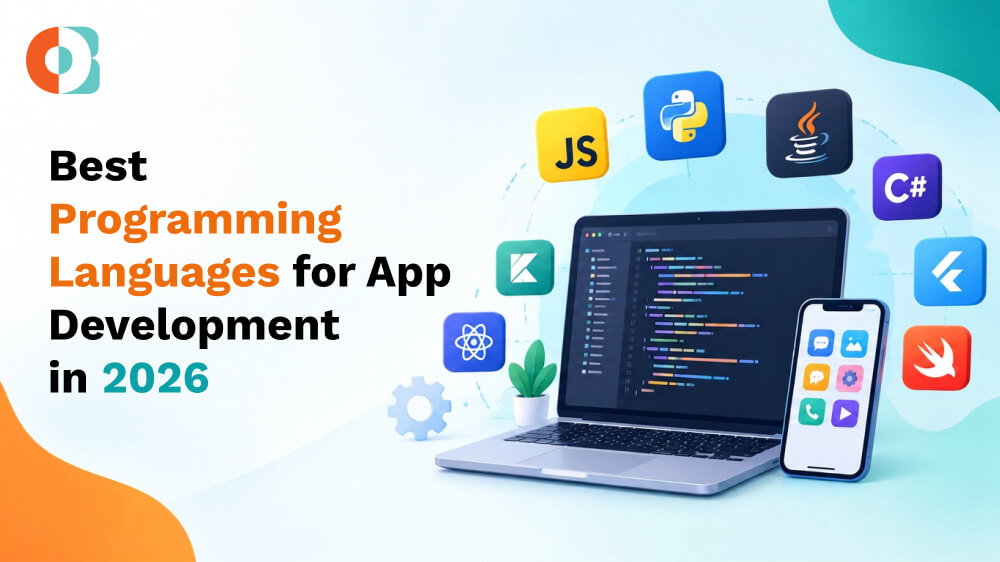
Best Programming Languages for App Development in 2026
Nobody downloads an app because of the language it's written in. Still, that quiet choice sits behind everything users do notice, from how fast screens load, how often the app crashes, to how quickly new features appear.
Get it right, and the project feels smooth; get it wrong, and you'll spend months untangling code, hunting for niche talent, or rebuilding from scratch. Hence, picking the best language for mobile app development deserves a proper conversation before anyone writes a line of code.
This guide walks through the leading programming languages for app development in 2026. Moreover, you will also see how to choose, which mistakes to dodge, and where things are heading.
Why Choosing the Right Programming Language Matters
Think of the language as the foundation under a house. Nobody admires it, but every wall, window, and extension depends on it.
- Performance: Native compiled languages often ensure better animations and faster startup times.
- Hiring and Cost: Programming languages with a larger talent pool offer lower costs in salaries and onboarding.
- Security: Type-safe languages can easily catch different types of bugs before users ever hit them.
- Scale:A mature ecosystem makes adding features (and users) far less painful.
Anyone hunting for the best programming language for mobile apps has to balance all four at once. A blazing-fast language with a tiny talent pool can still sink a project. Hence, for the full journey from idea to launch, you will need a detailed guide to mobile app development.
Native vs Cross-Platform Programming Languages
Before comparing individual languages, pick a lane between native and cross-platform. The two paths use different app development languages, and the trade-offs hit your budget directly.
Native Languages
Native app development means using each platform's official language, so Swift for iOS and Kotlin for Android. You get the best performance, the smoothest interfaces, and day-one access to new device features. The only thing to worry about is that two different codebases, which usually means higher costs and a longer road to launch.
Cross-Platform Languages
Cross-platform app development flips that deal. One codebase runs on both iOS and Android, so effort drops sharply. Dart with Flutter and JavaScript or TypeScript with React Native lead the pack in 2026, and the old performance gap has shrunk to the point where most business apps never notice it.
| Factor | Native | Cross-Platform |
|---|---|---|
| Languages | Swift, Kotlin, Java | Dart, JavaScript, TypeScript, C# |
| Performance | Highest | Near-native |
| Codebases | Two separate | One shared |
| Cost and speed | Higher, slower | Lower, faster |
| Best for | Complex, hardware-heavy apps | MVPs and business apps |
Teams eyeing a web-first shortcut can look at hybrid app development for lightweight, content-heavy apps.
Top Programming Languages for App Development in 2026
There's no single winner. A handful of languages, though, power most of the apps you actually use. GitHub's Octoverse 2025 report found that nearly 80% of new repositories used just six mainstream languages, which says plenty about where the safe bets are.
Swift: The iOS Standard
Swift is Apple's own language for iPhone, iPad, Mac, and Watch apps, and LinkedIn and Airbnb both use it. It's fast, type-safe, and plugged straight into Face ID, ARKit, and Core ML, so it's hard to beat for Apple-only products. Teams can start with iOS app development with a Swift programming specialist.
Kotlin: The Android Favorite
Among programming languages for Android app development, Kotlin now leads for new builds. Null safety and short, readable syntax mean fewer crashes and less boilerplate in Kotlin app development projects. Google Pay and Pinterest use it, and Kotlin Multiplatform lets teams share logic with iOS.
Java: The Reliable Veteran
Java hasn't gone anywhere; it still keeps plenty of enterprise software, backend systems, and older Android apps running. So many developers know that hiring rarely turns into a struggle, and maintenance costs stay predictable. If you already own a Java app, there's usually no reason to tear it out, since Kotlin works alongside it and you can move over a piece at a time.
Dart and Flutter: The Cross-Platform Star
Flutter, built on Dart, lets a single codebase produce iOS, Android, web, and desktop apps. It compiles ahead of time, so performance lands close to native, and hot reload lets you tweak a layout and see it on screen within moments. That combination is a big reason why startups reach for it when they want polished interfaces without doubling the team.
JavaScript and TypeScript: The Web-to-Mobile Bridge
React Native lets JavaScript and TypeScript developers build real mobile apps with tools they already know. TypeScript is among the fastest-growing languages, mostly because it catches errors before an app ships. Aim for smart development with dedicated React Native developers, and your web and mobile application can share most of the code.
Python: The AI and Backend Engine
Python rarely draws the screens, but it often runs everything behind them. Recommendations, chatbots, and personalization lean on its machine learning libraries. Combine Python development with specialist AI development services and smart features reach users without slowing releases down.
Compare two or three programming languages against your real requirements first. Even big brands mix languages, often pairing native apps with Python or Go backends.
Programming Languages for Web App Development
Web apps play by different rules. They run in browsers and lean hard on server-side logic. Plenty of programming languages for application development overlap here, but a few stand out for the web.
JavaScript and TypeScript
JavaScript runs in every browser, and roughly 66% of developers use it, according to Statista. React, Angular, and Vue handle the interface while Node.js covers APIs and real-time features. You can also compare PERN vs MERN and >NestJS vs NextJS to narrow the stack for your website development.
Python and Django
Python plus Django builds secure, data-driven web apps fast, especially dashboards, portals, and AI platforms. With Django, you get authentication, an admin panel, and solid security defaults out of the box. But to use them smartly, you need to know where using these programming languages pays off for growing companies.
Must Read: Top 10 Uses of Python in Business
PHP, Go and Beyond
PHP and Laravel still run a huge portion of the web, from content sites to custom portals. Laravel gives PHP projects a clean structure, while Golang suits high-traffic microservices and cloud tools. Therefore, to pick the best language for application development on the web, you need to sit and discuss it with the experts.
How to Choose the Right Programming Language for Your App
With such a long list of programming languages, you may wonder what to choose for your particular application. Well, then ask these five questions, as they will clear up most of the confusion. Work through them in order.
- Where will users be? iPhone-only points to Swift, Android-first to Kotlin, and both platforms to Flutter or React Native.
- How tight is the budget? Shared codebases launch faster, so cross-platform usually wins for MVP development and lean budgets.
- Who's on the team? A familiar stack beats a theoretically perfect one, every time.
- How demanding is the app? Games, AR, and heavy media justify native code or C++.
- What's coming next? Think about AI features, integrations, and growth now, because switching later will be costlier with time.
| Your app type | Suggested language |
|---|---|
| iPhone-only product | Swift |
| Android-first product | Kotlin |
| Startup MVP on both platforms | Dart (Flutter) |
| Social or marketplace app | JavaScript or TypeScript (React Native) |
| Enterprise app | Java or C# (.NET MAUI) |
| AI-heavy features | Python backend plus Flutter or React Native |
| Mobile game | C++ or C# |
Run your shortlist through those filters, and finding the best language for mobile app development gets much easier. And if you are worried about the budget, then check it on the app development cost calculator, as it gives a rough number before anything is committed.
Common Mistakes When Choosing a Programming Language
There are still some obstacles, and even smart companies still trip over the same few things. Dodge these mistakes, and you'll save months whenever you compare programming languages for app development for a new product.
- Following hype: A language that's trending on social media can still lack mature libraries, available talent, or long-term support.
- Ignoring the team: Forcing developers onto an unfamiliar language slows delivery and invites bugs into your system.
- Overbuilding the MVP: Two native codebases for an untested idea burn the budget that validation should have protected.
- Forgetting the backend: Teams argue about the front end for weeks while the database and APIs get zero attention.
- Assuming one size fits all: The programming languages for application development that suit a game rarely suit a banking app.
A good application development partner helps you avoid the risks of committing these recurring mistakes. Therefore, startups should also know how to hire the best developers for their projects.
Future Trends in App Development Languages
The programming languages keep shifting under developers' feet. Here's what's already visible.
- AI-focused development: Python and Swift with Core ML keep gaining attention as apps add smart features.
- Kotlin Multiplatform: Sharing business logic while keeping native interfaces appeals to teams that don't want duplicate work.
- TypeScript is everywhere: Type safety is becoming standard across React Native, backends, and web frontends.
- Rust in the core: Memory-safe modules for encryption and media processing are slowly entering mobile stacks.
- Blockchain and security: Fintech and Web3 apps pull interest toward Solidity, Rust, and Go as the programming language for blockchain development.
The best language for application development in 2027 will probably look familiar, just with smarter tooling around it. Hence, teams that review their stack every year will adapt faster in the future.
Conclusion
Your language choice quietly shapes cost, speed, security, and scale, so give it real thought before development starts. The strongest programming languages for app development in 2026 include Swift, Kotlin, Dart, TypeScript, C#, and Python. Pick the one that fits your platform, team, and budget, then test it with a small prototype.
Want a second opinion? A trusted mobile app development team can turn the plan into a product. Send your requirements through a quote request for a clear estimate and a technology recommendation.
Frequently Asked Questions
The choice of the best language for app development depends on the nature of the app itself as well as the target audience. If all the users are iPhone users, then it is obvious to use Swift, and Kotlin when developing an Android app.
Native languages target one platform each. Cross-platform tools share one codebase across several platforms. Native usually wins on raw performance, while cross-platform wins on cost and delivery speed.
Python is very important in designing the backend of the app, including recommendations, chatbots, data processing, and other similar operations. However, for frontend development, Flutter, React Native, or native languages perform better than Python.
JavaScript and Dart are the friendliest places to start. The syntax is forgiving, and when you get stuck, there's usually a free tutorial or an active community with the answer.
More than most people expect. The language shapes how many developers you need, how easy they are to find, how long the build takes, and what upkeep looks like a year down the line.
.jpg)