






A Comprehensive Guide To Intelligent App Development Cost Estimation
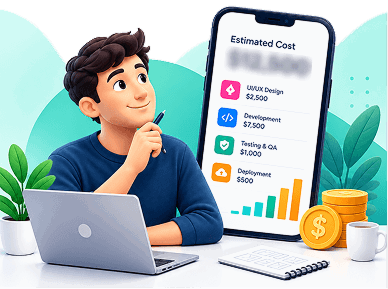
It can be hard to figure out how much an intelligent app really costs in this age of AI helpers, predictive analytics, and personalized digital experiences. No longer are screens and features the only things that affect your budget; data pipelines, machine-learning models, and cloud systems also play a role.
This guide breaks down intelligent app development cost into clear, business-friendly parts, so you can plan with confidence, avoid unexpected cost increases, and make sure that every dollar you spend leads to measurable results, lower risk, and long-term product growth for your company.
Owebest helps businesses architect, build, and scale AI-powered apps with predictable budgets and measurable outcomes.
Why Intelligent Apps Cost More Than “Normal” Apps
Most of the time, traditional apps only do CRUD tasks, simple logic, and standard integrations. Intelligent apps add extra layers, such as collecting data, labeling it, training models, inference pipelines, tracking, and always making things better.
According to research, the cost of making a mobile app can range from $37,913 to $171,450, based on how complicated it is. This is before you even think about adding AI features. It changes a lot when you add machine learning models, experimentation cycles, and cloud GPUs to that standard.
There is also a fast growth in the AI business itself. According to research, the global AI market will grow at a rate of 37.3% per year from 2023 to 2030. This is because many businesses will start using AI. That means the tools keep getting better, but you can also expect more from experiences that are led by AI. That's why the intelligence layer, not just screens and APIs, needs to be taken into account when estimating the cost of AI app development.
Key Factors That Shape Your AI App Budget
Although no two intelligent apps are exactly the same, there are a few factors that always affect how much intelligent app development cost:
Problem Complexity and Use Case:
A helpful chatbot that answers common questions (FAQs) costs less than an enterprise-level suggestion engine that works for many users. Any useful estimate should start with a clear understanding of what the app needs to do and what it would be nice to have later.
Data Availability and Quality:
AI can't do anything without data. You can save time and money if you already have clean, organized info. Having siloed, messy, or missing data means you'll need more engineering, ETL processes, and maybe even data labeling, all of which cost more.
Model Strategy (Off-The-Shelf vs Custom):
Other options include using pre-trained models or third-party APIs (such as vision, NLP, or recommendation APIs), which can speed up the original build process but may come with fees for continued use. It costs more up front to build a fully customized model, but it may pay off in the long run with better performance or lower costs.
Architecture, Integrations, and Scalability:
Choosing a cloud provider, apps vs. monolith, real-time vs. batch processing, and connecting to CRMs, ERPs, or IoT devices are all things that can affect the budget. Compliance and security standards for businesses add another layer.
Team Composition and Location:
There are more people on a cross-functional team (product, design, programmers, machine learning experts, DevOps, and QA) than on a small dev-only crew, but the team works better and has less risk. Rates depend on where the business is located as well. Compared to the US or Western Europe, nearshore and offshore models offer big saves.
Owebest helps you pick the right balance of architecture, tools, and team skills so you’re investing where it actually drives value.
Common Pricing Models For Intelligent App Projects
More than the amount they offer, how they charge you is very important. The more you know about smart app development pricing models, the more you can compare proposals fairly.
- Fixed-Price Projects: Best when needs are very clear and not likely to change. You get a clear idea of the project's goals, timeline, and price. However, changes made after the fact may cost a lot.
- Time-and-Material (T&M): You only pay for the time and resources you actually use. Ideal for AI projects that focus on new ideas and expect people to try new things. Scope can change, but to stop scope creep, you need strong control.
- Dedicated Team / Staff Augmentation: You contract a permanent staff to operate with yours similar to an additional department. Good to businesses or product companies which are churning out plenty of smart apps with time.
- Hybrid Models: With many AI projects, a fixed price and time and material (T&M) or dedicated staff work is most appropriate to continue evolving and optimizing.
A Step-By-Step Framework To Estimate Your Budget
Don't just ask, "How much will the AI app development cost?" Instead, estimate it in steps.
Step 1: Define Outcomes, Not Just Features
Make it clear which business KPIs the app needs to improve: retention, conversion, operational efficiency, or income per user. This makes sure that the estimate is based on real value, not just a list of features that would be nice to have.
Step 2: Map the Experience and Data Flows
Create general user paths and flows of data that illustrate the origin of data, how it is processed, and how AI concepts are presented on the UI. This has an impact on both ML and technical work.
Step 3: Break Work Into Modules
Divide the app into modules, each having its primary features, AI/ML components, administration tools, and integrations. It is simpler and more precise to be able to estimate the labour that will be applied to each component than to attempt to estimate the entire sum.
Step 4: Estimate By Complexity and Effort
Prepare a module work estimate depending on the level of difficulty (easy, medium, or complex) and the vacancy jobs that are to be filled (backend, frontend, machine learning, DevOps and quality assurance). You can at least get a rough estimate of the AI app development cost instead of making a wild guess at this point.
Step 5: Incorporate Non-Functional Requirements
A lot of the time, performance, security, observability, and compliance make things more difficult. You'll see clearly how each of these affects the intelligent app development cost.
Step 6: Add Contingency and Iteration Buffers
AI work is always ongoing. Include gaps for testing, fine-tuning the model, and problems with data that come up out of the blue. It is always better to have a reasonable estimate than a dreamy one.
Owebest helps clients see beyond the launch date, modelling total cost of ownership instead of just upfront build cost.
Conclusion: Build Confidently With Owebest
Smart apps can transform the way your business operates entirely, should you begin with clear goals, clean data, and a reasonable budget. When you put a estimate of smart app development cost, you are certain that you are making the correct investment of skills accordingly at the appropriate moment, without facing the danger of being off the track of your plans, or your cash.
Owebest uses its expertise in AI/ML, cloud-native technology, and user-centered design to transform complex concepts into scalable valuable products. Our team assists you in predicting, tracking, and optimizing the cost of developing your AI app at all its phases, including early finding and architecture strategy, launch, and continuous optimization. Owebest can assist you in creating a smart app with trust, provided you are willing to stop guessing.
FAQs
1. When should I start guessing how much my smart app will cost?
Your AI app development cost estimate should begin as soon as you have a clear problem description and a few user journeys. Early, rough figures help you choose whether to make a prototype, do a small test, or start making the MVP right away.
2. How can I keep the cost of my smart app low?
Start with a focused MVP, don't add too many edge-case features to the first release, and give priority to use cases that will have a big effect. Review the scope and results on a regular basis, and spend money on monitoring to find waste quickly.
3. Do I need a whole team of data scientists to make a smart app?
Not all the time. An expert app developer and ML engineers who use pre-trained models or third-party AI services can work together to start many projects. As your product gets better, you might hire data scientists to help you do more testing and make changes.