





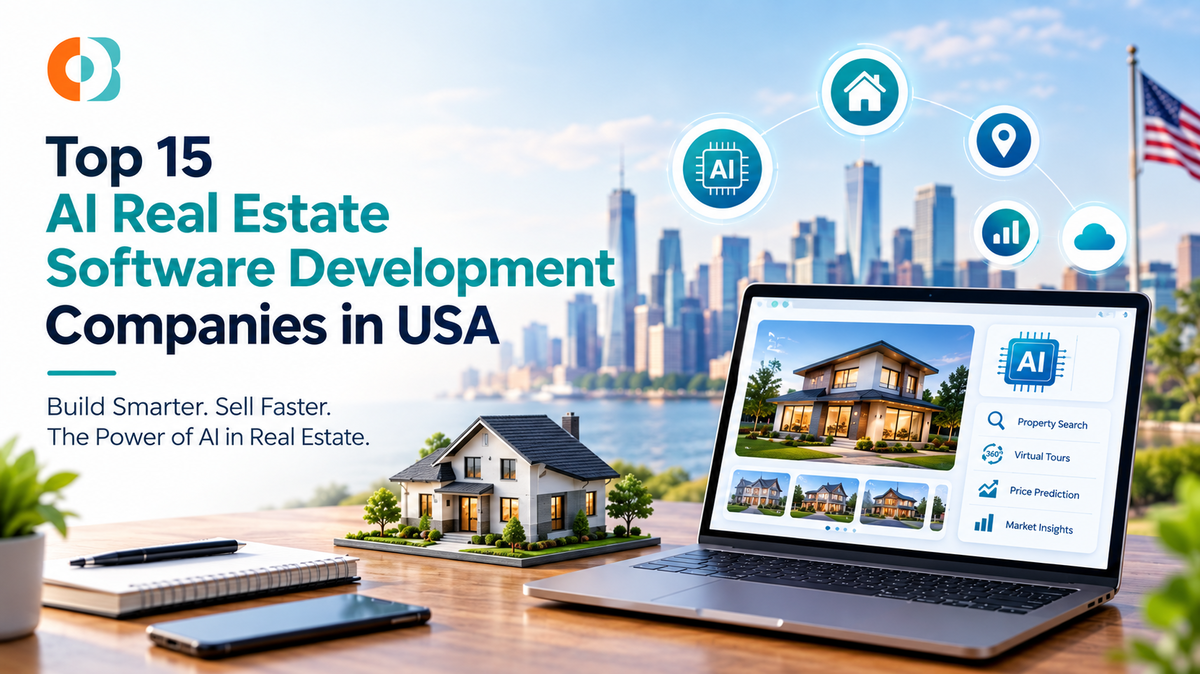
Top 15 AI Real Estate Software Development Companies in USA
If you just raised a seed round to build an AI property platform. You do not have an engineering team yet, and you do not have a CTO. Every agency you call says the same thing: “We do AI. We do real estate.” None of them can show you a live product, and half of them are repurposing a portfolio built for food delivery apps and calling it proptech experience.
If that's you, the question you are actually asking is: “Which AI real estate software development companies in USA have actually shipped a live product, and how do I avoid spending my seed round on the wrong partner?”
This is the problem this list is meant to solve. We looked at AI real estate software development companies in USA that have actually shipped property software, not agencies with a single AI case study and a slide about “the future of real estate.”
Some of the companies below are boutique PropTech specialists who have spent a decade building nothing but real estate tools. Others are large enterprise engineering firms where real estate is one industry among many, but the delivery record is real and verifiable. Both types belong on a list of top AI real estate software development companies, as long as the work checks out.
This is our list of custom AI real estate software development companies, a mix of USA-based AI real estate software development companies and AI PropTech development firms in USA that we could actually verify.
If you are planning to build something that competes with Zillow or Redfin, automate valuations for a lending desk, or bolt AI onto a property management platform your maintenance team already uses, this guide gives you fifteen names to start calling. For each one, you will see where they're based, how long they've been building software, and what kind of real estate work they've actually delivered.
We also cover how we evaluated this list, a side-by-side comparison table if you want to compare headquarters, team size, and specialization at a glance, and a section on red flags, the specific things vendors say when they don't have real AI or real estate experience.
Who Are These AI Real Estate Software Development Companies and What Do They Actually Deliver?
You keep getting proposals from app development agencies that quote your real estate project the same way they'd quote a food delivery app — no mention of MLS feeds, valuation logic, or Fair Housing compliance. If you've caught yourself thinking: “What does a genuine AI real estate solution provider in USA actually deliver, and how do I tell the difference on the next call?”, you are not the only one asking.
Or maybe you run a brokerage in Texas with about 200 agents. Your CRM, your MLS feed, and your lead routing tool all live in three separate systems that don't talk to each other, and agents lose leads because nobody knows which system has the latest contact. Your actual question is: “Who can build me one AI-driven platform around how my brokerage actually works, instead of another tool bolted on top of what I already have?”
Both problems come down to the same question: 'What should an AI real estate solution provider in USA actually build for me?' Below are the ten services that separate genuine AI PropTech software development companies and AI custom real estate software development services providers from a generalist agency.
These are the same ten services you should expect from any of the US-based AI real estate software development firms, AI property technology software solutions providers in USA, or other US firms that build AI real estate software you're evaluating.
1. Custom real estate platform development for web, iOS and Android
A real estate platform needs to handle listings, saved searches, agent dashboards, and buyer messaging across three platforms at once. Custom development means the data model is built around parcels, units, and listings from day one, not adapted from a generic e-commerce template. It should support MLS-driven listings, map-based search, and role-based access for agents, brokers, and admins.
2. Automated valuation model development and price prediction engines
An automated valuation model estimates a property's worth using comparable sales, tax records, location data, and market trends. Building one means training and testing a pricing model against real transaction data. Lenders, appraisers, and iBuyers use AVMs to price properties faster and flag outliers before a human reviews them.
3. AI powered property search, matching and recommendation systems
Instead of static filters, an AI-powered search engine learns what a buyer or renter actually wants from browsing behavior, saved listings, and search history. It ranks results by fit, not just by price or date listed. Done well, this cuts the time buyers spend scrolling through irrelevant listings and increases qualified inquiries agents receive.
4. AI real estate CRM development with lead scoring and nurture automation
A real estate CRM built with AI scores incoming leads by likelihood to convert, based on behavior like page views, form fills, and response time. It automates follow-up sequences so agents spend time on leads ready to move, not chasing cold contacts manually. This matters most for brokerages juggling leads across multiple channels.
5. AI property management software and tenant portal platforms
Property management software built with AI handles rent collection, maintenance requests, lease renewals, and tenant communication in one portal. AI layers on top to predict which tenants are likely to renew, flag late-payment risk early, and route maintenance requests to the right vendor automatically.
6. Predictive maintenance and smart building IoT integrations
Sensors on HVAC systems, elevators, and water lines feed data into a predictive maintenance model that flags equipment likely to fail before it breaks down. For property managers running large buildings, this means fewer emergency repair calls and lower maintenance costs, because problems get scheduled instead of showing up as emergencies.
7. AI document processing for lease abstraction, contracts and title workflows
Leases, contracts, and title documents are long and full of clauses that matter legally. AI document processing extracts key terms like rent amount, renewal dates, escalation clauses and flags inconsistencies automatically. This cuts the hours a legal or operations team spends manually reading a 40-page commercial lease.
8. MLS integration and real estate data integration services
Most real estate platforms need live listing data from an MLS, IDX feed, or the RESO Web API. This work is technical and compliance-heavy, since MLS rules on data display, refresh rates, and attribution vary by region. A company that has built these integrations before will move faster and avoid compliance mistakes.
9. Virtual tours, 3D walkthroughs and AI staging
Virtual tour and 3D walkthrough tools let buyers explore a property remotely before scheduling a visit. AI staging goes further, digitally furnishing empty rooms in photos so listings look move-in ready without the cost of physical staging. Both shorten the buyer's decision timeline, especially for out-of-state purchases.
10. Predictive analytics for real estate, investment dashboards and market intelligence
Investors and asset managers need dashboards that forecast rent growth, vacancy trends, and cap rate movement across markets, not just historical reports. Predictive analytics for real estate pulls in economic indicators, permit data, and comparable transactions to model where a market is heading.
How We Evaluated These AI Real Estate Software Development Companies in USA?
Before you trust any list like this one, you are right to ask: “How do I evaluate AI real estate software development companies in the first place?” Before we listed these fifteen companies, we had to settle that question ourselves, then apply the same standard to every name on the list. We did not rank by revenue, marketing spend, or who paid for a sponsored placement. Here is what we checked for, so you can judge this list on the same criteria we used instead of taking our word for it.
1. US registered entity or an established US delivery office
Every company on this list either has a US-registered legal entity or a real, staffed US office. This matters for contracts, IP ownership, and who you'd actually deal with if something goes wrong. A US presence also usually means the team understands US real estate compliance firsthand.
2. Demonstrable real estate or PropTech delivery work, not general AI case studies
We looked for actual real estate projects that had a named client, a described deliverable, a real estate tag on Clutch, or a dedicated case study and not a “generic we do AI page”. A company that built a chatbot for a retail brand is not automatically qualified to build a valuation engine.
3. Evidence of property data integration through MLS, IDX, RETS or RESO Web API
Companies that have connected to an MLS, IDX feed, or RESO Web API know the compliance rules around listing display and data refresh. This is a specific, learnable skill, and it shows up in project descriptions, case studies, or direct claims on a company's own real estate service pages.
4. In-house AI or data engineering capability rather than subcontracted delivery
We prioritized companies with in-house AI, ML, or data engineering teams, not agencies that outsource the AI portion of a project to a third-party contractor. In-house capability usually means faster iteration, more accountability if a model underperforms, and clearer IP ownership once the project ships.
5. Verifiable public client feedback on Clutch, GoodFirms or G2
We checked for reviews on Clutch, GoodFirms, or G2, platforms where clients leave verified feedback tied to a real project and budget range. A company with dozens of verified reviews across several years is easier to trust than one with a handful of five-star reviews and no other public track record.
6. Ability to cover product, AI and data compliance under a single contract
The best fit for most buyers is a company that can own product design, AI development, and data compliance work together, instead of forcing you to coordinate three separate vendors. Fewer handoffs mean fewer places for requirements to get lost between teams.
Top 15 AI Real Estate Software Development Companies in USA
Maybe you are shortlisting vendors this quarter to build an AI real estate platform in the USA. The problem is AI specialists do not understand property data, and real estate agencies cannot build models. If your question is: “Which companies can handle product, AI, and MLS data compliance under one contract, instead of me managing three separate vendors myself?”, the list below is built for you.
Or maybe you are managing a few thousand rental units on a system that's over a decade old, where maintenance triage is manual and renewals are guesswork. Your question is closer to: “How do I add AI to maintenance and renewals without migrating tenants off my current portal and losing half of them in the process?”
The fifteen companies below, a mix of custom AI real estate software development companies, AI PropTech software development companies, and US-based AI real estate software development agencies, cover both kinds of buyers. Whether you need companies in the USA that can build a property platform like Zillow, one of the few genuine Zillow and Redfin alternative development companies in USA, or a narrower feature build, you'll find a fit here.
1. Owebest Technologies
Website: https://www.owebest.com/
Founded: 2016
Clutch Rating: 4.9 out of 5, based on 27 verified reviews
Team Size: 50–249 employees
Pricing: Projects start around $5,000; hourly rate under $25/hr
If you're building an AI real estate platform in the USA and want a partner who treats your project as the priority, Owebest Technologies is built for exactly that brief. Being one of the leading AI real estate software development companies in USA, it has spent over a decade building software for clients who can't afford to get their data architecture wrong and real estate, fintech, and healthcare among them.
That matters more in this industry than most: a valuation engine trained on bad comparable data, or a CRM that mishandles buyer financial records, isn't a bug, it's a liability.
Owebest is CMMI Level 3 appraised and ISO 27001:2016 certified, holds Amazon Web Services Partner status, and was named among the Top USA App Developers by BusinessOfApps in 2022.
The company’s real estate work spans custom platform development, AI-powered property search and matching, and full-stack web and mobile builds, with a track record that includes property-matching platforms shipped end to end.
What separates Owebest from the names later on this list is scale, used deliberately: at 100 to 200 employees, Owebest stays small enough that a real estate client works with the same dedicated team from discovery through launch and post-launch support, instead of getting rerouted through account layers as the project grows.
Whether you're trying to build something that competes with Zillow, a narrower AI-driven search and valuation tool, or a property management portal with tenant-facing AI, Owebest's combination of AI development depth, real estate data integration experience, and CMMI-appraised process makes it the most credible mid-budget AI real estate software development company in the USA on this list.
It has blockchain and IoT capability on top, ready for smart-building monitoring and title-verification work as those use cases mature. If that fit sounds right, a scoping call with Owebest's team is the fastest way to confirm it.
2. Chetu Inc.
Chetu is a Florida-headquartered software development company, founded in 2000 and delivery centers in Birmingham, England. The company takes on industry-specific development across dozens of verticals, and real estate is one of them.
Clutch reviews show Chetu building custom accounting software for a real estate franchise and ongoing web portal development for a real estate advisory firm in Chicago.
Chetu's model leans toward custom software development for businesses that already know what they want built, rather than product strategy or ground-up platform design.
For a mid-budget real estate software development company in the USA that needs a developer or small team for a specific platform like an AVM, a lease-tracking feature, a custom CRM addition, Chetu's scale and willingness to take on smaller, defined-scope projects makes it a practical option among top rated AI real estate app developers USA.
This makes it one of the more practical mid budget real estate software development companies USA and a genuinely bespoke AI real estate software development company in USA for founders who don't need a full platform build.
3. RedBlink Technologies
Unlike broader IT outsourcing firms, RedBlink positions itself specifically around generative AI, machine learning, natural language processing, and chatbot development, services that map directly onto property search assistants and predictive analytics for real estate investment dashboards.
RedBlink's AI specialization can outperform a generalist software house, making it one of the more credible AI real estate platform development companies USA for a single-feature build.
RedBlink's stated approach starts with a consultation to understand the business problem before recommending an AI architecture, then moves into delivery: predictive models, recommendation engines, or NLP-driven chatbots, followed by post-deployment support.
For a startup that needs a focused AI feature like a lead-qualification chatbot or a property recommendation engine, RedBlink's AI specialization can outperform a generalist software house that only recently added AI to its services list.
4. ScienceSoft
What separates ScienceSoft from most companies on this list is a dedicated real estate practice, with specific service pages for real estate database development, real estate CRM development, and real estate marketing automation.
That specialization usually means ScienceSoft's teams have already solved common real estate data problems like smooth integration with CRMs, payment tools, and maintenance management software.
For property management companies or brokerages that want an AI real estate software development partner in USA with a documented, multi-decade real estate database track record, ScienceSoft's dedicated practice is worth a scoping call.
5. EPAM Systems
EPAM Systems is an NYSE-listed real estate software engineering company headquartered in Newtown, Pennsylvania. It is one of the largest publicly traded software engineering firms with a real estate practice, serving Forbes Global 2000 companies across dozens of industries, including real estate and PropTech, from offices across the US, Europe, and Asia.
EPAM's scale means it can staff large, complex AI programs like enterprise-wide data platforms, AI-native property management systems, or multi-market AVM development, with dedicated architects and data scientists working in parallel.
That scale comes with enterprise pricing and longer onboarding than smaller firms on this list. EPAM fits enterprise AI real estate software development companies buyers: large brokerages, institutional property owners, and REITs running a multi-year digital transformation program rather than a single-feature build.
6. PixelBrainy LLC
PixelBrainy LLC is a Wyoming-headquartered AI software development company founded in 2021, specializing in AI-powered software solutions, including real estate technology. It is smaller and newer than many other companies on this list. Real estate is one of its served industries, alongside e-commerce, healthcare, and hospitality, and accounts for approximately 10% of its client work based on the company’s published industry breakdown.
PixelBrainy's core strength is UI/UX design paired with full-stack development, which matters for real estate products where buyer trust often comes down to how a listing search or property dashboard actually feels to use.
For a founder with a tight first-release budget who needs a polished property search app or agent-facing dashboard built quickly, PixelBrainy is among the reasonably affordable AI real estate software development companies in USA option.
7. Clevertech
Clevertech is an AI real estate software development company in USA that works with enterprise clients on transformational digital products like platforms that interact with hundreds of millions of customers, transactions, or data points.
Clevertech doesn't market itself as a real estate specialist but its consultancy model, like small, cross-functional feature teams working directly with client stakeholders, suits real estate businesses that already have a product vision and need senior engineering talent to execute it.
For enterprise buyers who want a consultancy-style engagement rather than an outsourced development company, Clevertech is worth evaluating, particularly for teams comfortable with a distributed engineering team.
8. Vention
Vention, formerly iTechArt Group covers AI/ML, application development, cloud computing, data analytics, DevOps, IoT, and mobile and web development as core service lines, giving it a broader technical range than boutique AI shops.
Vention's scale and two decades of software delivery experience make it a reasonable fit for real estate businesses that need to combine several service lines in one development, say, an AI-powered property management platform that also needs IoT sensor integration for smart buildings plus a customer-facing mobile app.
Vention's per-project engagement model, rather than large multi-year-only contracts, means mid-market real estate companies can also engage it without committing to an open-ended retainer.
9. Itransition Inc.
Itransition explicitly lists real estate among the industries it serves, alongside media, finance, education, telecommunications, and healthcare, and describes its work as covering technology consulting, software engineering, product development, systems integration, and quality assurance for real estate clients specifically.
That combination of an explicit real estate vertical plus more than 25 years of enterprise software delivery puts Itransition for buyers who want documented real estate experience without going all the way up to EPAM-scale pricing.
Itransition's private equity backing also means it has the balance sheet to staff longer engagements, which matters for property management companies planning a multi-phase AI rollout.
10. SoftServe
SoftServe is one of the top AI real estate software development companies in USA that has more specific real estate proof points on this list like in 2003, Microsoft featured SoftServe's RE3W real estate application, built on the Microsoft .NET framework, at its annual developer conference.
More than two decades later, SoftServe's services have expanded into generative AI, cloud computing, big data, machine learning, and IoT, serving financial services, healthcare, retail, and other enterprise industries at scale.
For a buyer who wants deep AI/ML engineering bench strength backed by a long, verifiable software delivery history, the company's scale and documented track record make it a credible enterprise-tier option.
11. Intellectsoft
Intellectsoft describes itself as a custom software and AI engineering company, with named enterprise clients, a B2B smart-data platform built for a real estate consulting firm, according to a verified Clutch review.
Intellectsoft's project sizes range widely, from around $10,000 for smaller engagements up to $900,000-plus for larger builds.
For a founder who wants a New York-based AI engineering partner with production-grade AI systems experience and at least one verifiable real estate delivery, without committing to the scale of EPAM or SoftServe, Intellectsoft is a reasonable mid-tier option.
12. Simform
Simform specializes in cloud, data, and AI/ML engineering through a co-engineering delivery model, working alongside a client's internal team rather than fully replacing it.
Simform's real estate track record includes a documented engagement building a React Native mobile application and ongoing platform scaling work for New Home Star, a real estate company with 500-plus employees, according to a verified Clutch review.
For real estate companies that already have some internal engineering capacity and want a partner to extend that team, particularly for cloud infrastructure or AI/ML feature work, Simform's co-engineering model and Microsoft data and AI partner designations are worth evaluating.
13. Fingent
Fingent is an AI real estate software development firm in USA that runs a dedicated real estate technology practice, building property management, property maintenance, foreclosure management, rent management, and facility management software.
That kind of stated figure, combined with a real estate-specific service page rather than a generic industries list, puts Fingent among the more credible options on this list for property management-focused buyers specifically.
For a company managing several thousand rental units on aging software, Fingent's two decades of real estate-specific delivery, covering maintenance, leasing, and reporting workflows, make it worth a scoping conversation.
14. Zibtek
Zibtek positions itself around IT staff augmentation and custom software development for startups and Fortune 500 companies alike and its public project history includes web and mobile development for a real estate startup, alongside education, retail, and fintech clients.
Since Zibtek's model leans toward staff augmentation, adding developers to a client's existing team rather than owning a full product strategy, it suits founders who already have a product manager or technical advisor in place and need extra development capacity.
Zibtek's smaller size and Utah-based rates also make it one of the more affordable options on this list for teams with a tighter first-release budget.
15. Altoros
Altoros is focuses on cloud-native application development, customer analytics, blockchain, and AI for Global 2000 organizations, with named enterprise clients including Allstate, Cisco, and Autodesk.
Altoros does not run a dedicated real estate practice, and real estate isn't a named vertical in its public case studies. It closes this list as a reliable option specifically for enterprise buyers who already have real estate-specific requirements defined and need a consultancy with deep AI, blockchain, and cloud-native engineering experience to execute them.
A title-verification system built on blockchain being one plausible use case given Altoros's stated expertise.
Also Read: Real-estate App Development Cost and Features
Quick Comparison of the Best 15 AI Real Estate Software Development Companies in USA
You are comparing AI real estate software development companies in the USA, and the honest question is: “Who has time to read fifteen full profiles before I start outreach?” Here's headquarters, founding year, team size, and core specialization laid out side by side, so you can cut this list to four and start booking calls this week. Team size figures come from public company profiles and shift as companies grow, and also help which real estate development companies are best for startups versus enterprises, so treat them as a snapshot rather than an exact headcount. Let’s have a look at the comparison of the top AI real estate software companies in the USA.
|
Company |
Headquarters |
Founded |
Team Size |
Core AI Real Estate Specialisation |
Best Fit For |
|
Owebest Technologies |
Denver, USA |
2013 |
100–200 |
AI-powered platforms, property matching, mobile & web |
Startups & mid-budget teams needing a full-stack AI partner |
|
Chetu Inc. |
Clearwater, FL |
2000 |
1,000–9,999 |
Custom software for defined real estate tools |
Businesses needing one specific feature built |
|
RedBlink Technologies |
Danville, CA |
2008 |
100–249 |
Generative AI, NLP, chatbots, predictive analytics |
Teams needing one focused AI feature |
|
ScienceSoft |
McKinney, TX |
1989 |
500–750 |
Real estate databases, CRM, marketing automation |
Brokerages wanting a dedicated real estate practice |
|
EPAM Systems |
Newtown, PA |
1993 |
60,000+ |
Enterprise AI transformation at scale |
REITs & institutional owners running multi-year programs |
|
PixelBrainy LLC |
Sheridan, WY |
2021 |
Under 49 |
UI/UX-led product design and development |
Founders needing a polished app on a tight budget |
|
Clevertech |
New York, NY |
— |
~200 |
Remote-first enterprise consultancy |
Teams with a defined roadmap needing senior engineers |
|
Vention |
New York, NY |
2002 |
3,000+ |
AI/ML, cloud, IoT, mobile & web |
Multi-service builds combining AI with IoT or mobile |
|
Itransition Inc. |
Decatur, GA |
1998 |
3,000+ |
Explicit real estate vertical, enterprise delivery |
Property managers planning multi-phase AI rollouts |
|
SoftServe |
Austin, TX / Lviv, Ukraine |
1993 |
11,000+ |
AI/ML engineering at enterprise scale |
Buyers wanting deep AI bench strength |
|
Intellectsoft |
New York, NY |
2007 |
~200 |
Custom AI engineering, documented real estate client |
Mid-tier builds needing verifiable real estate proof |
|
Simform |
Orlando, FL |
2010 |
~800 |
Cloud, data, AI/ML co-engineering |
Teams with internal engineers needing extension |
|
Fingent |
White Plains, NY |
2003 |
500–1,000 |
Dedicated real estate & property management practice |
Property managers modernizing legacy systems |
|
Zibtek |
Draper, UT |
2009 |
100–150 |
IT staff augmentation |
Founders needing extra dev capacity, not strategy |
|
Altoros |
Pleasanton, CA |
2001 |
350–450 |
Cloud-native, blockchain, AI for enterprise |
Enterprise buyers with title-verification or blockchain needs |
How Can You Select the Best AI Real Estate Software Development Companies in USA?
Your budget is around $80,000 for a first release, and most enterprise agencies have quoted three times that without even running discovery. You don't want a cheap offshore build that falls apart in year two, but you also can't fund an enterprise-scale engagement, so you're asking: “Which credible US real estate software companies actually serve mid-budget projects like mine? Or how to choose an AI real estate software development company in USA?”
Or maybe you've been offered a white-label real estate platform that launches in eight weeks against a custom build that takes seven months, and your real worry is: “Will I hit a wall the moment I need a feature the white-label vendor doesn't support?” Both questions come down to the same six decisions.
1. Match the company to your stage, not its reputation
A well-known enterprise name isn't automatically the right fit for a seed-stage startup, and a boutique studio isn't automatically wrong for a large brokerage. Match team size and pricing model to where your business actually is, an MVP needs speed and flexibility, a REIT rollout needs process and compliance discipline. Reputation alone doesn't tell you which one you're getting.
2. Check real estate delivery proof, not general AI case studies
Ask for a named real estate client, a description of what was built, and ideally a link to a live product or a verified review. A company that built a chatbot for a retail brand hasn't necessarily solved the specific problems real estate data brings, MLS compliance, valuation logic, Fair Housing rules baked into search results.
3. Verify property data integration capability
If your platform needs live listing data, ask the vendor what MLS or IDX integrations they've built before, and how they handle data refresh and attribution rules. This is a specific technical skill, not something every software company picks up automatically, and getting it wrong can mean compliance problems later.
4. Decide between white label and custom build early
Not every vendor on this list offers both, check specifically which AI real estate software development companies with white label solutions you're actually talking to before you assume it's an option. A white-label platform launches faster and costs less upfront, but you're limited to features the vendor already supports. A custom build costs more and takes longer, but the platform is yours to extend however your business needs. Decide early, since switching from white label to custom mid-project usually means starting over that can help you choose the best AI real estate software development companies for startups.
5. Set a realistic budget band before outreach
Real estate software builds with meaningful AI components typically start in the tens of thousands of dollars for a defined feature, and run into six figures for a full platform. Knowing your budget band before you start calling vendors saves time on both sides. Getting a straight answer on AI real estate software development cost in USA before your first call saves everyone time.
6. Confirm code ownership, post-launch support and model retraining terms
Before signing, confirm in writing that you own the code and any trained models once the project ships, not every contract makes this automatic. Also ask what post-launch support costs, and how often an AI model like a valuation engine needs retraining to stay accurate as market data shifts.
Red Flags to Avoid While Selecting an AI Real Estate Software Development Company in USA
You shortlisted a few AI real estate software development companies in the USA, and two of them sounded excellent on the call, but neither could show a live property platform or explain how they pull listing data under a RESO-compliant feed.
Your doubt is simple: “How do I avoid signing a contract and discovering six months in that they've never built anything for real estate?” Every vendor deck says “AI-powered” on the first slide, but ask what model they use, what data it trains on, and how they handle bias in property recommendations, and the answers get vague fast.
So the real question becomes: “How do I verify AI capability in a real estate development company before I sign?” Here's what to watch for.
1. No live property platform they can demo or link to
If a company can't show a working real estate product, not screenshots, an actual link or demo, treat that as a serious gap. Every legitimate real estate software company should have at least one live example, even under NDA with details redacted.
2. Vague answers on MLS, IDX or RESO Web API data access
Ask directly how they'd pull listing data into your platform. A real answer names the specific integration method and mentions compliance requirements. A vague answer, “we can figure that out,” usually means they haven't done it before.
3. AI claimed with no model, training data or pipeline explained
“AI-powered” means nothing without specifics. Ask what model they'd use, what data it trains on, and how they'd handle bias in property recommendations or valuations. A company with real AI experience gives a clear, specific answer, not marketing language.
4. Portfolio screenshots that are template resales, not delivered products
Some agencies show polished mockups that were never actually built or shipped to a real client. Ask whether each portfolio piece is a live, delivered product or a design concept, and ask to speak with the client if possible.
5. Refusal to put code ownership and IP transfer terms in writing
If a vendor is vague or evasive about who owns the code and trained models after launch, that's a contract problem waiting to happen. Get IP transfer terms in writing before any work starts, not after the project is already underway.
6. A fixed quote given before any discovery has been run
A vendor that gives you a fixed price before understanding your data sources, integrations, and feature scope is guessing, not estimating. Real estate projects have enough moving parts, MLS access, compliance, legacy data, that a credible quote should follow a discovery phase, not precede it.
Final Thoughts on Choosing an AI Real Estate Software Development Partner in USA
Fifteen AI real estate software development partners in USA is a lot to read through, so narrow it down before you start outreach is a lot to read through, so narrow it down before you start outreach. Pick three or four names from this list based on fit, your budget, your stage, and whether you need a full product build or a defined feature added to something you already run.
Then use the verification questions from the red flags section on every call: ask for a live demo, ask how they handle MLS or RESO data access, and ask what model they'd actually use before anyone says the word “AI” again.
Additionally, you must run a paid discovery phase with your top pick before committing to a full build. It costs less than a failed six-month engagement, and it tells you quickly whether a vendor's real estate experience matches what they claimed on the sales call.
If you are weighing options and want to talk through your specific property data and AI requirements before committing to a vendor, Owebest Technologies offers a scoping conversation to walk through what your platform actually needs, reach out through our contact page to set one up. So let’s connect!
Frequently Asked Questions
There's no single best, it depends on your budget and stage. Owebest, ScienceSoft, and Fingent suit mid-budget teams wanting real estate-specific delivery experience. EPAM and SoftServe fit enterprise buyers needing scale. RedBlink and Intellectsoft fit teams needing a focused AI feature rather than a full platform build.
The costs vary by scope. A single AI feature like a chatbot or a basic valuation tool can start around $10,000 to $25,000. A full custom platform with MLS integration, AI search, and a CRM typically runs from $80,000 into six figures, and enterprise-scale programs cost more.
Most companies here focus on custom builds rather than white-label platforms. Custom builds cost more and take longer but give full ownership and flexibility to add features the way your business operates, instead of being limited to a vendor's template.
Yes. Most AI real estate software development companies on this list work with international clients and handle time zone overlap through distributed teams. What matters more than your location is whether your platform needs US-specific compliance work, like MLS or Fair Housing rules, which these companies are built to handle regardless of where you're based.
Several do. Owebest have documented real estate data integration work. You can ask directly during your first call whether they've connected to an MLS, IDX feed, or RESO Web API before, since this is a specific technical and compliance skill.
A single AI feature can ship in six to ten weeks. A full custom platform with MLS integration, AI search, and property management tools typically takes four to seven months, depending on scope. White-label platforms launch faster, often within eight to twelve weeks, but with less flexibility.
You can ask for a live demo, a named real estate client, and specifics about what model they use and what data it trains on. A company with real experience answers these questions directly. Vague answers, template portfolios, or a refusal to discuss MLS or RESO integration work are signs to walk away.
Most companies offer post-launch maintenance, bug fixes, and feature updates under a support contract. For AI-specific tools like valuation models, ask specifically about model retraining, pricing data shifts over time, and a model that is not retrained periodically becomes less accurate. Confirm retraining terms and costs before signing.
 in ai.jpg)