






AI Sports Betting App Development: Steps, Cost and Challenges
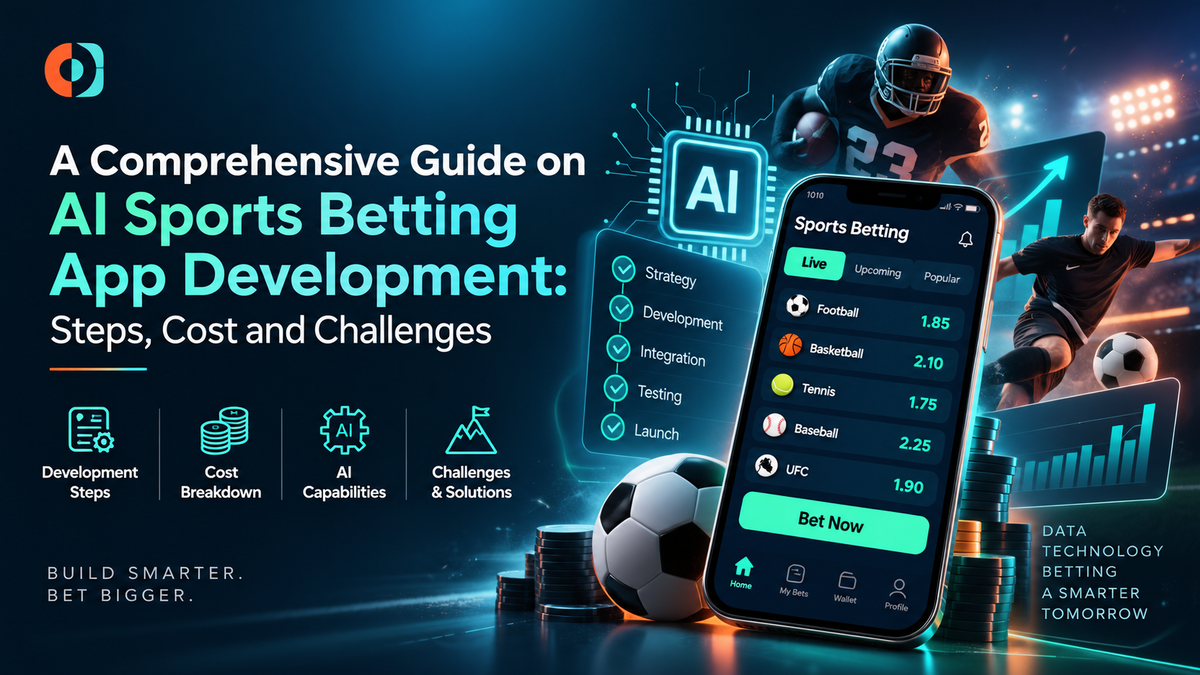
If you're asking, "Our team wants to launch an AI sports betting app in one state first and expand later. We need to know whether the initial architecture will support that or whether we will have to rebuild. How should we plan the AI sports betting app development?" This comes up in almost every planning conversation we have with operators, and the answer is no, you don't have to rebuild. It depends on what you build first.
Your compliance and KYC setup, your geolocation service, and your tax reporting all need to be built as separate, configurable pieces instead of being hardcoded for a single state. When they're built this way, adding a second or third state later mostly comes down to changing settings. When they're not, you end up rebuilding the same three systems every time you enter a new market.
More operators are planning for this kind of expansion because the market gives them a reason to. According to fortune business insights, the global sports betting industry is forecasted to grow from $126.51 billion in 2026 to $295.29 billion by 2034, which is why "one state first, more states later" has become the standard playbook.
None of that planning matters, though, if the app itself isn't built the right way underneath. Sports betting app development integrating AI means the AI sits at the center of the platform, not added on afterward. It prices the odds, manages risk, and decides what each user sees, while the rest of the app exists to feed it clean, real-time data.
No matter if you are a founder building your first sportsbook or an operator expanding into new states, the questions are the same: what to build, what it costs, and how to avoid rebuilding it in six months.
This guide of AI sports betting app development for startups covers which app types fit different budgets, which features matter most, realistic costs and timelines, how operators actually make money, and how to pick a development partner. By the end, you will know how to create an AI sports betting apps plan for custom AI sports betting application development that holds up well past your first state.
What Is an AI Sports Betting App and How Is It Different from a Traditional Sports Betting App?
An AI sports betting app is a sports betting platform that uses machine learning models to price odds, manage risk, and personalize the betting experience in real time.
An AI powered sportsbook app automates most of that. Odds move in real time based on live game data and betting patterns. Risk gets identified and rebalanced by algorithms instead of a trader noticing after the fact. Personalization, fraud detection, and parts of customer support can run on AI too.
However, a traditional sports betting app runs on fixed rules. Odds are set by human traders, updated on a schedule, and adjusted manually when there is heavy action on one side. Risk management relies on trader judgment and basic exposure limits.
There is a real difference. It changes staffing, infrastructure, and how fast the platform can react during a live event. Here is the table of diffrentiation between the two.
|
Aspect |
Traditional Sports Betting App |
AI Sports Betting App |
|
Odds setting |
Manual, trader-driven, updated periodically |
Automated, model-driven, updated in real time |
|
Live betting |
Limited, delayed updates during play |
Sub-second updates tied to live data feeds |
|
Risk management |
Human oversight, fixed exposure limits |
Algorithmic exposure monitoring and rebalancing |
|
Personalization |
Generic markets for all users |
Markets and offers tailored to betting history |
|
Fraud detection |
Rule-based flags, manual review |
Pattern recognition across large user datasets |
|
Scaling to new markets |
Requires manual re-pricing per market |
Models retrain and adapt with new data inputs |
|
Staffing |
Larger trading and risk teams |
Smaller teams supported by automated systems |
Neither model is better in every case. A traditional sports betting app development can be cheaper and simpler for a narrow, low-volume product. AI becomes worth the investment once you need speed, scale, or in-play markets that a manual trading desk just cannot price fast enough.
Why Sports Betting Companies and Sports Bettors Are Investing in AI Sports Betting Apps
It’s not just a trend. Businesses are actually investing in it. The global sports betting market is forecasted to reach from $126.51 billion in 2026 to $295.29 billion by 2034, and AI-driven odds and personalization are named as a direct driver of that growth. Here are five reasons why sports betting companies and bettors are backing AI-driven platforms.
1. Faster and more accurate odds
AI models process live game data and market movement far faster than a human trading desk. It matters most during in-play betting when prices need to update multiple times a minute.
2. Lower operating cost per market
Automated trading and risk models reduce the size of the human trading team needed to cover the same number of markets. It lowers the cost of adding new sports or leagues.
3. Stronger fraud and integrity monitoring
Machine learning models catch unusual betting patterns like coordinated arbitrage, suspicious volume spikes, faster than a person reviewing reports. Industry analysis points to AI-driven pattern detection as a growing part of integrity monitoring in regulated markets
4. Regulatory pressure is pushing adoption
Regulators expect real-time responsible gambling monitoring now, and AI systems that catch at-risk behavior as it happens are becoming part of what compliance teams look for
5. Bettor demand for live and personalised markets
Bettors are shifting toward mobile, in-play, and personalized betting experiences, and AI is the most practical way to serve individual markets at that scale.
For a sports bettor, this shows up as faster live odds, tighter markets, and personalised bet suggestions. For a sports betting company, it's margin protection and the ability to grow without hiring at the same pace.
Once a few large operators in a market run AI-driven pricing, competitors still running manual desks fall behind on speed and depth, and bettors feel that gap within seconds of a live game starting.
Also Read: Top 15 AI Sports Betting Software Development Companies in USA
Types of AI Sports Betting App Development for Various Sports Leagues
If funding is tight and you want to test demand before committing, a prediction and tipster app or a sport-specific app are your realistic starting points. Both allow you to find out whether people actually engage with AI-driven picks before you take on the cost and regulatory weight of handling real wagers. Here are all eight app types.
1. AI Full Sportsbook App
Pre-match and live markets across multiple sports, the DraftKings model. AI handles odds pricing and risk management across the full catalog. It covers moneylines, spreads, totals, parlays, and props in one platform.
This is the most expensive and most regulated option, since it needs licensing, full compliance infrastructure, and a trading team large enough to oversee automated pricing across every sport you carry.
For example: DraftKings, FanDuel, BetMGM, bet365
2. AI Live and In-Play Betting App
Built around real-time markets during a live game, with odds shifting based on what is happening on the field and fast settlement once a market resolves.
This needs low-latency data feeds and a pricing engine that reacts in under a second, along with a risk engine that can suspend a market instantly if the price moves faster than the system can update. A strong second phase once a full sportsbook is already live.
For example: bet365
3. AI Microbetting App
This is the most AI-dependent model. Bets are placed on individual plays, pitches, or possessions rather than the outcome of the whole game. This needs the tightest data latency and the most sophisticated pricing models.
Since a market might exist for only a few seconds before the next play starts. Usually a specialised add-on layered onto an existing live-betting product, not a first build for a new sports bettors.
For example: Betr
4. AI Betting Exchange Platform
The operator does not take the other side of a bet. Bettors wager against each other, and the platform takes a commission on winning bets, similar to how Betfair operates.
This shifts risk away from the operator and onto the bettors themselves, but it depends on having enough liquidity on both sides of a market to keep prices moving, which is a real challenge for a new, low-traffic platform.
For example: Betfair
5. AI Fantasy Sports and DFS App with Betting Integration
It combines daily fantasy sports contests with betting features that allow users to draft rosters and place wagers in one app. In some states, DFS runs under separate, lighter rules from traditional sports betting. This makes it a useful entry point into a state before a full sportsbook license is available or affordable.
For example: DraftKings
Also Read: Football App Development Guide with Trends, Ideas, Features and Cost
6. AI Prediction and Tipster App
Analytics only, no wagering. Users get AI-generated picks, win probabilities, or game analysis, and the app never processes a bet directly.
This carries a much lower regulatory burden since you are not licensed as a bookmaker. It is a common way to test demand for AI-driven content before committing to a full sportsbook build.
For example: Action Network and OddsJam
7. AI Sport-Specific Betting App
This specific AI sports betting app development is built around one sport or a small group of sports: football, basketball, baseball, golf, esports, or horse racing. A narrower scope means a smaller data integration footprint and a model that only has to learn one sport well. This means better prediction accuracy sooner than a platform trying to cover everything at once.
For example: TAB
8. AI White Label Sportsbook App
A pre-built platform licensed from a vendor and customised with your branding, colors, and app store listing. This is the fastest and cheapest way to market, though you have less control over the underlying AI models and technology stack. You stay dependent on the vendor's roadmap, pricing, and licensing terms.
For example: Kambi and SBTech
A question we hear often alongside this one: is a betting exchange easier or harder to build than a traditional sportsbook, and does it change your regulatory requirements? It is not necessarily easier to develop, you still need real-time matching and settlement.
But it can be lighter on capital reserve requirements, since you are not holding open risk positions the way a traditional sportsbook does. You still need a gambling license to operate legally in a regulated state.
Benefits of AI Sports Betting App Development for Operators
If you're asking, "We are running a sportsbook with a manual trading team and want to understand what AI would actually change for our margins before we commit a budget. What is the measurable business case?"
Here's the honest, measurable case: AI will not eliminate your trading and compliance staff, but it changes what they spend their time on, and it lets you cover more markets and more live events without headcount growing at the same rate. The revenue upside comes mainly from faster, tighter live odds and better fraud prevention. Take a look at the benefits of AI sports betting app development for operators.
1. More accurate odds and better margin protection
Continuous repricing narrows the window where a mispriced line gets exploited by sharp bettors. Instead of a trader manually adjusting a line after noticing heavy action, the model reacts the moment new data comes in. Over hundreds of markets a day, that speed adds up to real margin saved, not just a theoretical improvement.
2. Automated trading reduces headcount cost
One automated model can cover far more markets than one trader, changing the ratio of markets to trading staff. This doesn't mean cutting your trading team to zero, it means the team you do have can focus on exceptions and edge cases instead of routine repricing. Growth in market coverage stops being tied one-to-one to hiring.
3. Faster live market updates and lower latency
In-play markets can update in under a second instead of several seconds, which matters directly for live-betting revenue. That gap is exactly where sharp bettors look for an edge, so closing it protects money you'd otherwise lose. It also makes the live betting experience feel more responsive to users, which keeps them betting longer.
4. Personalised markets and higher retention
AI can surface bets tailored to a user's history, which platforms tie to higher engagement and repeat usage. A user who bets mostly on NFL player props sees more of those, not generic markets they'll scroll past. Over time, that relevance is what turns a one-time bettor into a returning one.
5. Automated fraud and arbitrage detection\
Pattern recognition across large bet volumes catches coordinated abuse a manual review team would likely miss until after the damage is done. It can flag accounts betting in sync across markets, or unusual volume spikes tied to a specific event, often before a payout even happens. That earlier catch is what keeps losses from arbitrage rings from piling up.
6. Scalable market coverage
Adding a new sport becomes a data and model exercise, not a new trading desk hire. You're plugging in a new data feed and training a model on it, rather than recruiting and onboarding traders who specialise in that sport. That difference is often what makes expanding into a new league financially viable in the first place.
7. Better regulatory reporting and responsible gambling monitoring
Automated systems flag at-risk behavior in real time and generate the audit trails regulators expect. Instead of compiling reports manually after the fact, you have a continuous record ready when a regulator asks for one. It also means problem gambling patterns get caught while there's still time to intervene.
Also Read: How to Build a Fantasy Sports Mobile App like Dream11?
Core and Advanced Features to Consider While Building an AI Sports Betting App
"Our app needs live in-play betting with sub-second odds updates across multiple sports. This is the single feature our users ask for most. What does building actually require?" If that's the question on your mind, the answer is not one feature, it's three working together: a low-latency data feed contract with a sports data provider, a pricing engine that recalculates odds continuously, and a risk engine that can auto-suspend a market for milliseconds when it detects a sudden move.
If you skip any one of the three and sub-second, it will not hold up once real traffic hits during a live event. These pieces, along with everything else your app needs, are covered in the core and advanced feature list below of AI sports betting app development.
Core Features
|
Feature |
What It Does |
|
User registration and KYC |
It verifies identity and age before a user can deposit or bet |
|
Geolocation verification |
It confirms the user is physically inside a licensed state |
|
Odds and markets display |
It shows pre-match and live odds across supported sports |
|
Bet slip and placement |
This allows users to build and confirm a wager |
|
Wallet and payments |
Handles deposits, withdrawals, and balance management |
|
Live scores and data feed |
Pulls real-time game data to support live markets |
|
Push notifications |
Alerts users to odds changes, results, and promotions |
|
Responsible gambling tools |
Deposit limits, self-exclusion, and reality checks |
|
Betting history and statements |
It allows users to review past bets, wins, and losses |
|
Multi-sport and multi-league support |
It organises markets in different sports in one app |
|
Admin and trading dashboard |
It enables internal teams to monitor markets and exposure |
|
Customer support and help center |
In-app chat, FAQs, and dispute handling |
Advanced Features
|
Feature |
What It Does |
|
Real-time AI odds engine |
Reprices markets continuously from live data |
|
Sub-second in-play pricing |
Updates odds during live play with minimal lag |
|
AI risk and exposure management |
Automatically rebalances liability across markets |
|
Personalised market recommendations |
Suggests bets based on individual user history |
|
AI fraud and arbitrage detection |
Flags suspicious betting patterns automatically |
|
Predictive analytics dashboards |
Surfaces model-driven insights for trading teams |
|
Automated model retraining pipeline |
Keeps prediction models current as new data arrives |
|
Multi-state compliance engine |
Applies state-specific rules automatically by location |
|
Cash-out and bet editing |
Lets users settle or adjust an open bet before the event ends |
|
AI chat and virtual assistant |
Answers user queries and surfaces relevant markets |
|
Social and community betting features |
Lets users share picks or compete on leaderboards |
How to Build an AI Sports Betting App: A Step-by-Step Process
Developing an AI sports betting app needs a clear roadmap that includes steps:
- Define business model and app type
- Plan licensing and compliance requirements
- Scope MVP features and pick tech stack
- Design the UI//UX for betting workflow
- Integrate sports data feeds and build real-time engine
- Develop and train the AI prediction models
- Integrate payment, wallet, KYC, and GEO compliance
- Test, certify, launch, and maintain models
When you follow the development of AI sports betting app process accordingly, you can build a robust AI sports betting app within budget.
1. Define Your Business Model, Target States, and App Type
Firstly, decide what you are developing. Is it a full sportsbook, a prediction app, an exchange, or something narrower? This one decision drives your licensing path, data needs, and budget. If you plan to launch in one state first, choose a state with a simple licensing process.
Because the infrastructure you build for that state becomes the template for every state after it. Also, decide roughly how many states you want to be in within two to three years, since that number shapes how much you invest in configurable, multi-state architecture upfront.
2. Plan Licensing and Compliance Requirements Upfront
Sports betting is regulated state by state in the US. Licensing fees alone can range from roughly $50,000 to $1 million or more depending on the state, and some states cap the number of licenses available, pushing new entrants toward secondary-market deals or tribal partnerships.
Bring in a gaming attorney before development starts. Build your compliance data model like KYC records, audit logs, geolocation rules as a shared service you can configure per state.
3. Scope MVP Features and Finalise the Tech Stack
Now, decide what version one actually needs versus what can wait. A realistic MVP usually includes registration and KYC, geolocation, a limited set of pre-match markets, wallet and payments.
Live in-play betting and advanced AI personalization are usually phase-two additions. You can write down what is explicitly out of scope, so the team is not re-litigating features mid-development. Choose a stack that supports low-latency data processing and can scale horizontally.
4. Design the UI and UX for Betting Workflows
Betting UX has its own specific demands: users need to see odds changes instantly, confirm bets in as few taps as possible, and understand what they are wagering before they commit.
Decide upfront how the app handles an odds change between opening the bet slip and confirming the bet, whether it auto-accepts small movements or prompts the user, and make that behavior visible in the UI.
5. Integrate Sports Data Feeds and Build the Real-Time Odds Engine
This is the technical core of an AI sports betting app development. You need a reliable, low-latency data feed provider and an odds engine that consumes that data to price markets continuously.
For in-play betting, a few hundred milliseconds of delay is the difference between a fair market and one bettors can exploit by reacting faster than your system updates.
6. Develop and Train the AI Prediction and Risk Management Models
Now, build the models that price markets, flag risk exposure, and detect fraud. Early models will run into a cold-start problem, without historical data, initial predictions are less accurate than they become after months of live use.
You can start with more conservative odds margins and tighter risk limits until enough real data accumulates. Also, decide which models you build in-house and which you license.
For instance, odds prediction for major sports often benefits from a licensed data and modeling partner, while fraud detection and personalization are more commonly built in-house on your own user data.
7. Integrate Payments, Wallet, KYC, and Geolocation Compliance
After that, the development team will integrate payment processors that support gambling transactions specifically, since many mainstream processors decline gambling-related businesses.
Also, integrate a KYC provider for identity verification and a geolocation service to confirm users are betting from a legal jurisdiction. Regulators will not approve a launch until these work correctly.
8. Test, Certify, Launch, and Retrain Models Post-Launch
Before you launch an AI sports betting app, your app needs independent testing and certification of odds integrity, payment security, and responsible gambling tools.
After launch, treat model retraining as an ongoing task like betting patterns and player behavior shift over a season, and models left untouched drift and lose accuracy.
Lastly, set up a monitoring dashboard before launch that tracks model accuracy, odds latency, and exposure limits in one place, and assign someone to review it daily during the first few months.
Also Read: AI In Sports: Redefining the Sports Industry with Real-World Examples
How Much Does It Cost to Develop an AI Sports Betting App?
Founders often ask how much it costs to develop an AI sports betting app, and what makes the price vary so much between vendors. It is common to receive quotes between 80k and 200k for what sounds like the same product. The AI sports betting app development costs range from $30,000 to $200,000 or more, depending on app type and scope.
|
App Type |
Typical Cost Range |
What Drives It |
|
Prediction / tipster app (no wagering) |
$30,000 – $60,000 |
No payments, KYC, or licensing engineering |
|
Sport-specific or single-market app |
$50,000 – $100,000 |
Narrower data and model scope |
|
Single-state sportsbook (core betting) |
$80,000 – $150,000 |
Full KYC, payments, geolocation, custom AI odds |
|
Full multi-sport sportsbook with live betting |
$150,000 – $200,000+ |
Live in-play engine, multi-state architecture |
What separates an 80k quote from a 200k quote for what looks like the same feature list usually comes down to three things: whether AI models are built and trained from scratch or licensed from a third party, how much of the compliance and geolocation work is custom versus outsourced to providers, and whether the vendor is pricing for one state or a multi-state-ready architecture from the start.
The other question that comes up constantly is what the ongoing costs look like after the app goes live. Data feed licensing and server costs come up often, but few vendors give founders the full picture upfront. Well, this table clears all your doubts.
|
Ongoing Cost |
What It Covers |
|
Sports data feed licensing |
Recurring fee based on sports covered and data granularity |
|
Cloud infrastructure |
Scales during peak live events; billed on usage |
|
Payment processing fees |
Per-transaction cost from gambling-approved processors |
|
Geolocation and KYC provider fees |
Per-check or subscription cost |
|
Model retraining and monitoring |
Ongoing data science and infrastructure time |
|
Compliance and licensing renewal |
Legal costs to maintain licenses across states |
These recurring AI sports betting app development costs commonly run into the huge dollars per month even for a modest single-state launch, and scale up as you add states and live sports coverage.
How Long Does It Take to Build an AI Sports Betting App?
The time it takes to make an AI sports betting app is not fixed. It depends on your project's scope and requirements. If you're asking "how long does it take to build an AI sports betting app from kickoff to launch? We need to time our launch around a major sporting season," here's what you need to know about the timeline.
|
App Type |
Typical Timeline |
|
Prediction / tipster app (no wagering) |
3 – 4 months |
|
Single-state sportsbook, core features |
5 – 8 months |
|
Full AI sportsbook with live betting, multi-state ready |
9 – 14 months |
Licensing timelines, which can run 3 to 12 months per state depending on the jurisdiction, are usually the hurdles, not development itself. A small prediction or tipster app without wagering can launch fastest since it skips licensing and payment integration entirely.
A single-state sportsbook with core betting features runs longer mainly because development and licensing have to happen in parallel rather than one after the other.
A full custom sports betting app development with live in-play betting and multi-state readiness sits at the top end, largely because you are coordinating development, data integration, and licensing across more than one jurisdiction at once.
If you are targeting a season launch, work backward from that date. Start licensing applications in parallel with early development and build in a 4-8 week buffer for independent testing and certification before you can go live.
Treating certification as the last step, rather than something planned for early, is one of the more common reasons a launch slips past a season deadline.
Best Technologies for AI Sports Betting App Development
“What tech stack do the best AI sports betting apps use and does the choice actually matter for us? We are non-technical founders trying to evaluate vendor proposals.” As a startup founder, you do not need to become a developer, but the tech stack choice does matter in a few specific ways. It affects how fast live odds can update, how well the platform scales during peak traffic, and how easily you can add states or sports later.
Here is the table showing the best tech stack you can consider for AI sports betting app development.
|
Layer |
Common Technology Choices |
Why It Matters |
|
Backend |
Node.js, Python, Java, Go |
Handles real-time data processing and API traffic |
|
AI/ML frameworks |
TensorFlow, PyTorch, Scikit-learn |
Powers odds prediction, risk, and fraud models |
|
Mobile frontend |
React Native, Flutter, Swift, Kotlin |
Determines app performance and platform reach |
|
Web frontend |
React, Next.js, Angular |
Powers the desktop and mobile web experience |
|
Database |
PostgreSQL, MongoDB, Redis |
Redis or similar in-memory stores are key for low-latency odds |
|
Data streaming |
Apache Kafka, WebSockets |
Moves live game data to the odds engine with minimal delay |
|
Cloud infrastructure |
AWS, Google Cloud, Azure |
Needs to auto-scale during peak live-event traffic |
|
Geolocation |
GeoComply or equivalent |
Industry-standard for US gambling geolocation compliance |
|
Payments |
Gambling-specific payment processors |
Standard processors often decline gambling transactions |
The choice that matters most for a non-technical founder to push on is the data streaming layer and how odds get cached, since this determines whether real-time odds are actually real-time or just fast-refreshing. If a vendor cannot clearly explain how they handle live data streaming, ask more questions before signing.
Top Monetisation Strategies for an AI Sports Betting App
Sports betting companies or sports bettors often want to know “How do sports betting apps actually make money beyond the house edge, and which revenue models work for a smaller operator? We need a revenue model our investors will take seriously.”
Here are nine monetization strategies, in order of how much investors and operators actually rely on them.
1. Betting margin (the vig or hold)
The core revenue model for an AI sports betting app: odds are priced so the operator retains a small percentage of total handle regardless of outcome.
This remains the most defensible model for a licensed sportsbook and the one investors expect to see as your primary line. Every other model on this list works best as a supplement to margin for any app that actually processes wagers.
2. Commission on exchange volume
If you are running a betting exchange, revenue will come from a commission on winning bets rather than a built-in margin. This works well for smaller businesses because it does not require holding large risk reserves. Although it depends on having enough bettors on both sides of a market to keep liquidity healthy.
3. Subscription and premium tiers
You can charge for premium features like advanced AI insights, exclusive markets, or an ad-free experience, independent of betting activity. This gives you predictable monthly revenue that does not swing with betting volume, which investors tend to like.
4. In-app advertising and sponsored markets
You can sell ad placements or sponsored content within the app. Particularly relevant for prediction apps that cannot rely on betting margin, though it usually needs meaningful user volume before it becomes a serious revenue line.
5. Affiliate and referral revenue
The next model is earning commission by referring users to licensed sportsbook partners. A common and low-overhead model for prediction and content-only apps, since you earn revenue without ever holding a gambling license yourself.
6. Freemium prediction and tipster models
You can offer basic picks for free and charge for premium, higher-confidence AI predictions or deeper analytics. It works best when your free tier is genuinely useful enough to build trust before asking users to pay.
7. White labelling your own platform
Once you have a working platform, licensing it to other businesses for a fee becomes a secondary revenue stream. This only works once your own platform is proven and stable, since you are now supporting someone else's business on top of your own.
8. Data monetisation
Another monetization model is selling anonymised or aggregated betting trend data to media, analytics firms, or other operators, where regulations permit. This is usually a smaller, later-stage revenue line rather than something to plan around early.
9. Bonus and promotion economics
Structuring deposit bonuses and promotions to drive acquisition and retention while managing the cost against expected lifetime value. If you do this wrong and promotions become a drag on margin rather than a growth lever, so model the payback period before launching any offer broadly.
“We are building a prediction app rather than a full sportsbook so we cannot take a margin on bets. What monetisation options do we realistically have?” If you are building a prediction app rather than a full AI sports betting app, you cannot take a margin on bets, so the monetisation question looks different. Realistically, you have subscriptions, affiliate revenue, in-app advertising, and freemium tipster models, usually combined rather than relied on alone.
Challenges in AI Sports Betting App Development and How to Solve Them
Most founders underestimate a handful of specific challenges to build an AI sports betting app. It is better to know them now than to discover them months later.
|
Challenge |
Why It Happens |
Solution |
|
Latency during peak live events |
Odds updates fall behind during high-traffic moments, like a major game night |
Faster data feed contract, an in-memory database layer for live odds, and load testing specifically for peak-traffic scenarios. |
|
Prediction accuracy and cold start |
New models lack historical betting data and underperform early on |
You can start with wider odds margins and tighter risk limits, and pre-train models on publicly available historical sports data before launch |
|
Multi-state regulatory complexity |
Each state sets its own rules, fees, and restrictions |
Developers must build compliance logic as a configurable, state-aware service instead of hardcoding rules for one state |
|
KYC and AML friction at signup |
Heavy identity checks cause high drop-off during onboarding |
You can ask for minimal information to place a small first bet; request deeper KYC only when a user withdraws or deposits above a set threshold |
|
Data feed cost and dependency |
Sports data providers charge significant recurring fees, and losing a feed can break live betting |
Negotiate contract terms carefully and keep a backup data provider for critical sports and events |
|
Arbitrage bettors and fraud |
Sophisticated bettors look for pricing gaps or exploit slow-updating odds |
AI-driven pattern detection across bet volume and timing, layered with manual review for edge cases |
|
Scaling for major sporting events |
Traffic during events like a championship spikes far beyond normal load |
Auto-scaling cloud infrastructure, load-tested against realistic peak scenarios well before the event |
|
Model retraining and drift |
Models left untouched become less accurate as team and player behavior shift over a season |
Developers must build retraining into the operational calendar as a routine task, not an occasional fix |
If you're already running into latency problems during peak events, with odds updating too slowly on live markets, it is best to know this is almost always a data or infrastructure challenge. You should check your data feed contract's latency guarantee first, then confirm you are using an in-memory store for live odds rather than a standard database. After that, load-test specifically against your busiest historical event.
This is also where the KYC, AML, and geolocation compliance question usually comes up. How to handle it without wrecking the signup experience when onboarding drop-off is already high. The solution is usually about sequencing, not the requirements themselves.
You must ask for the minimum needed to place a small first bet, then request deeper KYC only when a user tries to withdraw or deposit above a threshold. That is how many regulated AI sports betting app development platforms balance compliance with a workable signup flow.
Custom Build vs White Label AI Sports Betting App: Which Is Right for Your Business
“Should we build a custom AI sports betting app or start with a white label sportsbook? We want to live within six months but we also want to own our technology long term.” Many businesses who are planning to develop an AI sportsbook have this question in mind.
Well, this decision usually comes down to which constraint matters more right now: speed or ownership. To help you get an answer, check out the below comparison table of white label vs custom AI sports betting app development.
|
Factor |
White Label |
Custom Build |
|
Time to launch |
Weeks to a couple of months |
5 to 14 months depending on scope |
|
Upfront cost |
Lower |
Higher |
|
Ongoing cost |
Revenue share or license fee to vendor |
No ongoing platform fee, but you own maintenance |
|
Control over AI models |
Limited to vendor's roadmap |
Full control |
|
Data ownership |
Often shared or vendor-controlled |
Fully yours |
|
Best for |
Fast market entry, testing demand |
Long-term ownership, differentiated product |
Some sports betting businesses split the difference. They launch on a white label platform in the first state to hit a market window, and build a custom platform in parallel, then migrate once it's ready. This costs more overall than choosing one path, but it solves the speed-vs. ownership tension when both genuinely matter to you.
Legal and Compliance Requirements for Sports Betting Apps in the USA
A common question many businesses ask. “What licenses do we actually need to launch a sports betting app in the USA and how does that change if we launch in three states? We do not want to build something we cannot legally operate.” Sports betting is regulated at the state level, not federally. There is no single national license, so you need one in every state where you operate. Let’s take a look at AI sports betting app compliance requirements:
Core requirements state by state:
Here are the legal requirements to build AI sports betting app in USA
- A state gaming license (fees commonly range from $50,000 to $1 million or more).
- Background and financial viability review of the business and its principals
- Integration with a state-approved geolocation provider
- KYC and age verification processes
- Integration with state or national self-exclusion databases
- Responsible gambling tools: deposit limits, reality checks, session limits
Launching in three states:
- Expect a sequential process, not simultaneous approvals, in most cases.
- Secure an anchor state first, its documentation can be reused for follow-on applications, which is faster than filing from scratch each time.
- Some states cap the number of licenses available, which can push new entrants toward tribal partnerships or buying an existing license.
Do not treat compliance as a step that happens after the app is built. Bring in a gaming attorney during planning, and build KYC, geolocation, and audit logging as configurable systems from the start, so a second or third state is a configuration exercise rather than a rebuild project.
How to Choose the Right AI Sports Betting App Development Partner?
Nearly every vendor will tell you they have AI expertise. You might want to know: “How do we verify that a development company genuinely has AI capability rather than just wrapping an off the shelf model? Every vendor we have spoken to claims machine learning expertise.” To help you, we have jotted down some major points that you can consider while choosing the right AI sports betting app development partner.
1. Ask about their model-building experience
You should ask to see a past project where the vendor built or trained a prediction or risk model. Also, ask what data the model was trained on, how accuracy is measured, and how it gets retrained after launch.
A vendor that has only integrated a third-party odds API will struggle here. That is a signal to dig deeper, since integrating a proven third-party model is a reasonable choice for some projects.
2. Ask about gambling-specific compliance experience
You must ask them about their track record with geolocation integration, KYC providers, and state licensing support. A vendor with genuine sports betting experience will name specific providers they have integrated before, not offer general statements about regulatory expertise.
3. Ask for relevant references
Asking for references is also important. So ask for references from past sportsbook or betting app clients specifically, not general fintech or ecommerce clients, since the compliance and latency requirements here are specialised.
4. Ask how they handle life after launch
You can ask them how they handle post-launch model retraining and ongoing support. A one-time development with no retraining plan will degrade in accuracy over time.
5. Watch for this red flag
A vendor who cannot explain the difference between using a third-party odds API and creating an AI sports betting app model, but still markets themselves as an AI sports betting app development company. You must ask for a working demo of a model in action before committing the budget.
How Owebest Can Help in Your AI Sports Betting App Development Journey?
Owebest Technologies is a leading AI sports betting software development company. We build custom sportsbook, exchange, and prediction platforms for operators planning single-state launches and multi-state expansion alike.
Our team brings together machine learning, predictive analytics, cloud infrastructure, and sportsbook development, and we use all of it to build betting apps that hold up once real money and real traffic hit them.
If you are starting a sportsbook from zero or you have one and need to upgrade, we develop it to scale and build it around what your business actually needs.
What we handle end to end:
- Real-time AI odds and risk engines
- Live sports data feed integration
- KYC, AML, and geolocation compliance
- Multi-state, configurable architecture
- Post-launch model monitoring and retraining
Demo Project: Multi-State Live Betting Module
A regional sportsbook client came to us preparing for a multi-state rollout, running on a single-state development that could not scale. We delivered:
- A real-time odds engine integrated with a low-latency sports data feed.
- An automated risk management layer to rebalance exposure during live events.
- A compliance framework built to be configurable by state to the client's original launch state.
Result: The client could add a new state by configuring rules instead of rebuilding core systems, which cut the expansion timeline for each additional state significantly compared to their original single-state development.
Book a free consultation with Owebest Technologies to create AI-powered platforms that keep your users engaged, your operations running clean, and your business growing well past launch day.
Conclusion
AI sports betting is no longer optional if you want to compete. Sports bettors expect fast odds, live markets, and accurate predictions, and businesses who do not offer that are already losing ground to the ones who do.
Getting there takes the right plan, the right app type, the right state to start in, and a team that has experience in AI sports betting app development before.
If you are looking to build an AI-powered sportsbook, prediction app, or betting exchange, Owebest Technologies can help you plan it the right way from day one. Get in touch, and let's talk about what your app really needs.
Frequently Asked Questions
It depends on your app type and licensing timeline. A prediction app without wagering can realistically launch in 3 to 4 months. A licensed sportsbook needs 6 to 9 months or more once licensing time is factored in, so work backward from your target date and start licensing early.
If speed matters most right now, white label gets you live faster and cheaper upfront. If long-term ownership and control matter more, custom is the better fit, even though it takes longer and costs more to start.
Subscriptions for premium picks, affiliate revenue from referring users to licensed sportsbooks, in-app advertising, and freemium tipster models are the realistic options, usually combined rather than used alone.
Around $150,000 typically covers a solid single-state sportsbook MVP development with core betting features and a functioning AI odds engine, or a more advanced prediction and analytics app with room to spare. A full multi-sport live betting platform usually needs more.
Yes, if your existing app has a reasonably modern data architecture. AI odds prediction can be layered in as a service that feeds into your existing pricing logic, though how much rework is needed depends on how your current system ingests live data.
Full sportsbook apps, live and in-play betting apps, microbetting apps, betting exchange platforms, fantasy sports apps with betting integration, prediction and tipster apps, sport-specific apps, and white label sportsbook apps.
 in ai.jpg)