
Your infrastructure works. The question is whether it's working hard enough. Most enterprise systems weren't built to collaborate; they were built to function in isolation. Owebest Technologies changes that equation without changing what you have. With our AI integration services, we embed AI directly into your existing CRMs, ERPs, mobile apps, and web platforms, connecting your data and automating the workflows your team still handles manually.
Your systems are already running. We make them work together with AI built in. No rip-and-replace. No disruption. Just your existing CRM, ERP, and mobile apps finally working as one and doing more.
The gap between AI-enabled enterprises and those still evaluating is no longer theoretical; it shows up in revenue, headcount efficiency, and customer retention. The companies we work with that delayed by 12 months didn't just fall behind on technology. They spent that year watching competitors move faster, shorter sales cycles, leaner support teams, processes that used to take days running in minutes. By the time the evaluation was done, the gap wasn't a quarter behind. It was structural.
However, the real challenge isn't finding an AI tool. It's embedding artificial intelligence into existing operations without breaking workflows or compromising data security. That's the problem most leadership teams are quietly sitting with, and it's exactly where the wrong partner costs you more than doing nothing.
Owebest Technologies works differently. We assess your current stack, identify where AI delivers the highest return, and build the right capabilities into what you already run, cleanly, securely, and with outcomes your board can actually report on. From AI chatbot development services that resolve thousands of customer interactions without adding headcount, to autonomous agents and machine learning layers, we architect and deliver it end-to-end.
An AI agent that lives outside your existing workflows is not an integration. It is a separate tool your team has to remember to check.
The agents we build are wired directly into the platforms that drive your operations, your ERP for purchase order matching and approval routing, your CRM for lead qualification and follow-up sequencing, your ticketing system for escalation handling, and your communication stack for vendor notifications.
The most common enterprise chatbot failure is not a bad bot. It is a bot that has no idea what is happening in the rest of your business.
As a part of our AI chatbot development services, we integrate conversational AI directly into the systems your customer-facing operations run on. That means a live bidirectional connection to Salesforce or HubSpot, so the bot reads the customer's account history before saying a word and logs every interaction back automatically.
It ensures seamless integration into your order management system, so the bot can pull real-time order status rather than deflecting to a human.
Explore AI Chatbot DevelopmentThe gap between a general-purpose LLM and one that is actually useful inside your enterprise comes down to one thing: connection to your real data.
We handle the full integration stack. RAG pipelines that connect the model to your live internal knowledge sources, documentation, product databases, and past case records, so every output is grounded in current, proprietary information rather than generic training data.
Most integration projects run into problems that were visible before the project started. Data that is not structured well enough to feed a model. Systems with no API access. Workflow processes that have not been documented. Compliance exposure that was not mapped upfront.
With the aim to bring out the best AI integration solutions, we run a structured readiness audit before any integration development begins.
We look at your data quality, your API surface area, where your infrastructure creates integration constraints, where your workflows have manual steps that AI can own, and where compliance requirements will shape what is possible.
An AI integration is only as good as the data it connects to and the workflows it operates in. Both change. A product catalog gets updated. A new CRM field gets added. A workflow process gets restructured. When those things happen without the AI layer keeping pace, the outputs degrade, and most teams do not notice until it is already a user-facing problem.
We implement automated monitoring against the performance benchmarks we document before going live. We track model output quality, data pipeline integrity, and response accuracy on an ongoing basis.
Also, when drift appears, we catch it at the metrics level before your customers or your internal teams do.
Three clients. Three problems that were costing real money. Here's what changed.
1,400 loan applications a week. Analysts reviewing each one manually across three disconnected systems. We embedded a real-time risk model into their origination workflow, connected to their core banking, credit bureau API, and Salesforce. Standard applications now clear automatically. Analysts only see exceptions.
Clinical staff losing 2.5 hours per shift to documentation across three EMR systems. We built a HIPAA-compliant AI layer that auto-generates structured notes post-consultation and unifies patient history across all 14 sites. No system migration. No disruption to existing workflows.
14 lost production days in one year. Maintenance on fixed schedules, not machine condition. Sensor data existed, nobody had time to watch it. We connected a predictive model to their existing sensors and surfaced alerts directly inside the ERP their team already used. Failures got predicted. Downtime stopped.
We assess your infrastructure, data quality, workflow inefficiencies, and business goals. This phase also maps where AI integration services create the highest-impact opportunities before a final line of code is written.
Our architects design the integration blueprint, selecting models, APIs, and the best infrastructure patterns, which are aligned to your stack, compliance requirements, and greater scalability targets. With us, you can receive a documented roadmap with accurate timelines and ROI projections.
Our engineers build, connect, and validate the best AI solution within your latest systems. From API development, model fine-tuning on your data, UI/UX integration, security hardening, and end-to-end QA, our team can successfully handle everything.
Before full deployment, we run a properly controlled pilot against your defined KPIs, measuring accuracy, processing speed, workflow efficiency gains, and system stability. No enterprise-wide rollout until the final performance benchmarks are perfectly met.
We don't just hand over a deployed system to clients, rather, we run structured onboarding for your team, document every workflow we've touched, and stay available for 30 days post-launch to ensure everything works in line.
We implement the best model monitoring, smart performance dashboards, and scheduled retraining cycles through which we can keep an eye on the results. Your AI development services investment is also well-designed to improve over time.
Our AI integration solutions have brought the best operational improvements for enterprise clients across:
Patient volumes are high, administrative workflows are fragmented, and clinical staff spend too much time on manual tasks. We integrate AI Chatbot directly into telehealth platforms and hospital management systems, connecting patient handling automation, predictive scheduling, and documentation workflows under a unified platform.
Fraud moves fast, and manual review does not scale. We embed real-time detection models into your existing transaction-processing pipelines and integrate AI-assisted screening directly into underwriting and compliance workflows, so risk decisions happen at the speed your operations require, without adding review headcount or creating separate systems your teams have to manage alongside what they already use.
Disconnected data is what keeps most retail AI projects from delivering. We integrate recommendation engines into your existing product catalog, checkout flow, and customer data infrastructure, and connect inventory forecasting models to your supply chain systems. Thus, you can make decisions driven by live data, not batch reports running hours behind your actual business.
At Logistics and Supply Chain, we connect route optimization agents into your dispatch and fleet management platforms and integrate predictive maintenance models directly with your equipment monitoring infrastructure, giving your operations teams actionable intelligence inside the systems they already use to make daily decisions, not in a separate dashboard they have to check separately.
Course creation is slow, and learner engagement is hard to sustain at scale. We integrate LLM-powered tutoring assistants into your existing learning management systems and connect automated content-generation tools into your course-authoring workflows, so your teams produce more, learners get more responsive support, and the platform does the heavy lifting your instructional staff should not have to carry manually.
Unplanned downtime is one of the most expensive problems on the production floor, and one of the most preventable. We integrate sensor-connected predictive maintenance models directly into your production infrastructure, so your engineering and operations teams get early warnings inside the monitoring tools they already rely on, well before a failure forces a line stoppage.
Every AI integration solutions we bring has to clear your internal security review, not just work technically. Here's what that looks like in practice.
For healthcare and fintech clients, we architect compliance-first from day one, not as a post-build checklist. Your security team reviews the architecture before a single line of integration code is written.
If your environment requires that AI models never leave your infrastructure, we support fully private model deployment within your own VPC, no data transits external APIs.
Data residency requirements? We scope region-specific deployment (AWS, Azure, GCP) at the architecture stage, not as an afterthought during go-live.
All engagements include SLA-backed post-deployment monitoring. Also, the terms are scoped at contract stage.
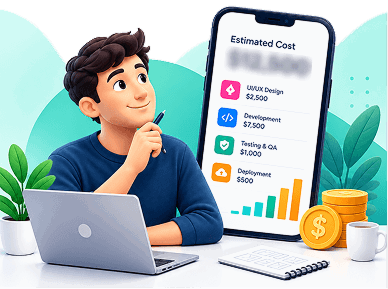
A focused and single-use-case AI integration, typically starts between $8,000 and $20,000. Mid-complexity projects generally fall between $25,000 and $75,000. However, most mid-complexity engagements return that investment within the first two quarters, typically through headcount efficiency alone, before you factor in error reduction or process speed gains. Enterprise-wide artificial intelligence integration services pricing may exceed $100,000 in total engagement value.
Short answer: yes, and that is precisely what they are designed for. We do not ask you to rip out what is already working. Whether your environment is built around a legacy ERP that is fifteen years old, a modern CRM like Salesforce or HubSpot, a custom-built internal platform, or a mobile application, we build the connectors and API layers that make everything talk to each other cleanly.
Building from scratch means developing your own models, training pipelines, and infrastructure through a significant investment in time, budget, and internal capability. AI integration solutions take a different route where we embed existing AI capabilities, pre-trained models, LLMs, ML frameworks, or third-party AI services directly into your current systems and workflows.
A focused AI chatbot development services engagement, one channel, integrated with your CRM, typically wraps up in four to eight weeks. Mid-complexity AI agent development services projects involving multi-system integrations generally run eight to fourteen weeks. If you are looking at enterprise-wide artificial intelligence integration services spanning multiple platforms and business units, budget three to six months. Whatever the scope, you get a written timeline commitment before work starts.
We have delivered AI integration solutions across healthcare, fintech, e-commerce, logistics, education, real estate, and manufacturing. The pattern we keep seeing is consistent: the strongest returns show up where transaction volumes are high, where decision-making is repetitive and rule-bound, or where the customer interaction surface is large enough that manual handling simply cannot keep pace.
Before you start an AI integration project, you need a real operational issue that you are actually facing. You need proper access to the people who own your relevant systems. And you also need a rough budget range in mind. Rest, when you connect to your team, we handle the data audit, infrastructure assessment, and roadmap. You bring the business context; we bring everything else.
We build security into the architecture from the start, not just check it at the end. We use role-based access controls, AES-256 encrypted data pipelines, private cloud deployments in your VPC, and seamless API authentication standards like OAuth 2.0 and JWT.
Yes. Every engagement includes a well-structured post-deployment support. Our AI development services model is also successfully built for long-term partnership, not project handoff. We offer flexible SLA-based support packages for enterprise clients.
Absolutely. Instead of opting for a full-project team, you can hire dedicated AI developers from our team. We also have skilled ML engineers, NLP specialists, and LLM integration developers, and AI agent architects directly into your team who can successfully perform different tasks as per your needs. However, a minimum engagement of 1 month which can successfully meet the needs of long-term teams.
No obligation. No jargon. Just a focused conversation about what AI can do for your business backed by the team who have done it 500+ times.